Yesterday I ventured to my favorite Evanston beach, longing for a sight of the wildflowers I knew would be there. I also walked along the shore and remembered a poem I had written last year about collecting sea glass in this season. Here it is.
Springtime is sea glass season.
Early spring:
when the ice floes have dissolved again into churning lake,
but new leaves are only a thought curled in a budding branch.
The freshly-freed pebbles cast shadows on the wet and gleaming sand,
and lying between them
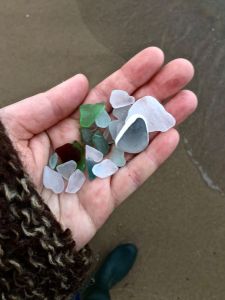
are rounded, sanded shards:
creamy white, jade green, coffee brown,
and oh-so-rarely
a weathered but brilliant blue.
The foraging is not hard:
wander along the waves
(it’s best in rubber boots)
until a shining flash or impossible color
catches your eye;
scoop up the object, with as little sand as possible;
rinse if necessary,
and if the surface isn’t still cloudy when wet,
the sea glass is not yep ripe;
the edges should be smoothed,
like the pebbles at your feet.
If the sea glass is ready,
slip it into your pocket
to clink with all the other treasures there.
You’ll know you have enough
when your pockets weigh heavier than your boots.
But if the sea glass is not ready,
if the patina washes off with the sand,
or a lingering sharpness remains,
there is still a job to be done.
Gently bury the shard in the crunchy sand
or toss it with vigor into the waves.
The earth and the water will continue their work,
slowly wearing down the sharp edges
and the shiny surfaces,
the brokenness softening into pieces rounded enough to hold,
until something miraculous remains,
something that another beach-goer,
with pockets weighed down
and boots squelching,
will gather in
and carry home,
or throw back to the water,
to begin again
and again
and again
the journey to ripening.
 cassidhe hart