The word of the Lord was rare in those days

I don’t remember why, but I was reading the story of Samuel and his mother Hannah in the book of 1st Samuel, and I was struck by a phrase that recurred several times: “the word of the Lord was rare in those days.” So I decided to write some song lyrics inspired by my meditation on the story.

1. 
The word of God was quiet then,
and visions weren’t so widely known.
Prayers were made by violent men,
who claimed the Holy as their own, 

When Hannah came to Shiloh’s heights
and fell upon its sacred ground. 
She poured her offering of tears,
mouthing words without a sound.

“Don’t forget me, Holy One,
don’t ignore my desperate cry. 
If we can’t hear you, are you listening? 
Do you hear each anguished ‘why’?”

2. 
The word of God was quiet then,
and visions weren’t so widely known, 
so Hannah left and looked for hope 
all along the journey home. 

An answer swelled within her womb, 
a promise grew into her son.
When he was weaned, she brought him back 
in thanks for all the Lord had done. 

“I remember, Holy One,
how you listened to my cry.” 
Hannah turned her prayer to song
and lifted praise to Adonai: 

3. 
(The word of God was quiet then, 
and visions weren’t so widely known.) 
“My heart rejoices in the Lord.” 
She sang, “My strength’s in God alone.” 

“The mighty warrior’s bow has snapped; 
the stumbling ones are clothed in pow’r.
The barren woman rocks her child; 
the hungry feast on manna shower. 
 
“You remember, Holy One,
and you listen to our cry. 
Before I questioned, you were listening,
Before I asked, you gave reply.” 

4. 
The word of God was quiet then, 
and visions weren’t so widely known,
but Hannah sang with joyful faith
and nurtured seeds of hope she’d sown. 

Did her son, the prophet Samuel,
learn from her what listening means? 
Were the words of God so silent?
Whose holy visions were unseen? 

We remember, Holy One:
We must learn to hear your cry,
not in those who grasp at power,
but in the outcast asking why. 
“My God,” shouts out the suff’ring Lord 

Written last year as we catapulted into the fullness of the pandemic and Holy Week.

To the tune of KINGSFOLD (To Mock Your Reign)

“My God,” shouts out the suff’ring Lord, 

“Why have you forsaken me?” 

Our king and the Incarnate Word

Has pow’r for just one plea. 

His body bears an anguished pain

Beyond the heavy cross. 

No human language can contain

This emptiness of loss. 

“My God,” yells out the hungry child,

“Why are you so far from me?” 

Their body, dirty and reviled, 

Is home to Deity: 

The lonely Christ is present there

And joins the tearful cry

That dares to give voice to despair

And hungers for reply. 

“My God,” cries out the broken Earth,

“Can you not hear my groan?”

This planet to which God gave birth

Now reaps what we have sown. 

The Lord of Life with flesh of clay

Is there in every death,

In each extinction, every way

Creation gasps for breath. 

“Where are you, God?” the desperate pray

As they reach out for a word. 

Both midnight and the brightest day,

They question who has heard. 

The lonely, sick, abused, and poor – 

Christ joins them from the cross

And echoes from his wounded core

The fullness of their loss. 

Gradual but fierce

For the first time in five months, I picked up my violin. A fall and subsequent wrist injury kept me not only from playing my violin but also from riding my bike, picking up pots and pans, opening doors without pain, getting lids off jars, and even driving. But after five months, I finally felt ready to try the violin for two minutes or so. It’s been a long wait. My hand, which has gained a good deal of strength over the past month, nevertheless shook from disuse as I struggled to move the tuning pegs. My pinky was clumsy as it pressed down the strings. But the music soared out. IMG_0752

In this time of recovery, I’ve learned and re-learned some important lessons about healing, lessons that are valid for all types of injury and restoration: personal, relational, societal. They aren’t universal truths, necessarily, but landmarks, reminders of the nature of becoming whole.

1. Healing is gradual but also fierce.

I had to be patient with the slow pace of my gathering strength, but I also couldn’t sit down and just wait for things to get better. I had to create the conditions for my healing. When I tried to do everything at once, my wrist rebelled with biting and throbbing pain. But if I neglected my exercises (or stopped using my wrist altogether), there was no hope of meaningful steps forward. I had to push my muscles, tendons, ligaments, and scar tissue every day, further than was comfortable but never beyond my capability. It was hard to notice my capacity growing, but my ability to bring out my violin today is proof that it has grown. I had to learn to balance sustained effort with gracious welcome. I’m not a master at it, but I’ve certainly gotten a lot of practice.

2. Consequently, recovery isn’t linear.

If I accidentally overdid things by trying to weed the garden or sleeping without a brace on, I might set back the process by days or weeks. Sometimes a good day would be followed by an abysmal day, and I would have to start all over again. I couldn’t predict the pace – I could only listen and be patient.

3. Visible trauma does not dictate the extent of harm.

When I fell onto the sidewalk back in March, my hand looked as though the only result was a mild abrasion. There was no swelling, very little blood, and nothing suggesting a severe injury. But the next day, I couldn’t move my hand. And my continued pain, weakness, and numbness was testament to the fact that something was indeed wrong. An MRI gave no further clues, but not once did my doctors suggest that my pain and difficulty moving wasn’t real. The hand and wrist is a complex system, they said, and it takes a long time to heal. So we made our best guesses as to the diagnosis and moved through therapy accordingly. Some of my own reading has been about the neuroscience of pain and the persistence of learned neural pathways after an injury. Whatever the cause of my pain, ignoring it was not going to produce healing. Only careful listening coupled with expansive thinking would allow us all to get to the root of my pain.

4. Everything is connected.

When I really started getting my arm back into gear, I noticed increased pain and tension in my shoulder blade. My muscles aren’t used to having an active arm, and they responded accordingly with protest. Nothing about my injury or healing is isolated. What I do in once place means paying attention to another place. 

It isn’t hard to see the common threads in these lessons: patience and listening. And I would qualify these as a relentless patience and a spacious listening; there is nothing soft or easy or quiet about the work of recovery. But wherever you or your community, or our whole world for that matter, may be in messy work of healing, we can know that a sustained and gracious effort will open us up to each other and to possibility.

Of Music and Mochi

Despite the wind’s wintery bite, Wednesday was a day of hygge (that newly ubiquitous Danish word), permeated by an inner sense of coziness and capped with little moments of happiness.

One of my favorite parts, appropriately, was listening to an album by a group called the Danish String Quartet. I first came across their music in NPR’s Tiny Desk concert series, and in a break from the quartet’s usual classical fare, they played their own arrangements of Danish folk songs. I fell in love. And then I did somersaults of joy when I discovered they had not one but two albums of such musical bliss.

As I was driving home from work Wednesday, I had their album Last Leaf blasting (can one blast string quartet folk music?) and I watched the pink sky mellow into dusk. (I also watched the road, of course, so don’t worry.) The track “Shine You No More,” which I have heard innumerable times now, blew me away once again and set my feet itching to dance. I heard in the “Unst Boat Song” the sorrow and joy and longing of 100 lives, and it invites you to write your own experiences into the music, too, whatever they are that day.

Music like this buoys my spirit when gray January settles in. It reminds me of the life that pulses even in the quietest moments and celebrates the softness and introspection of winter.

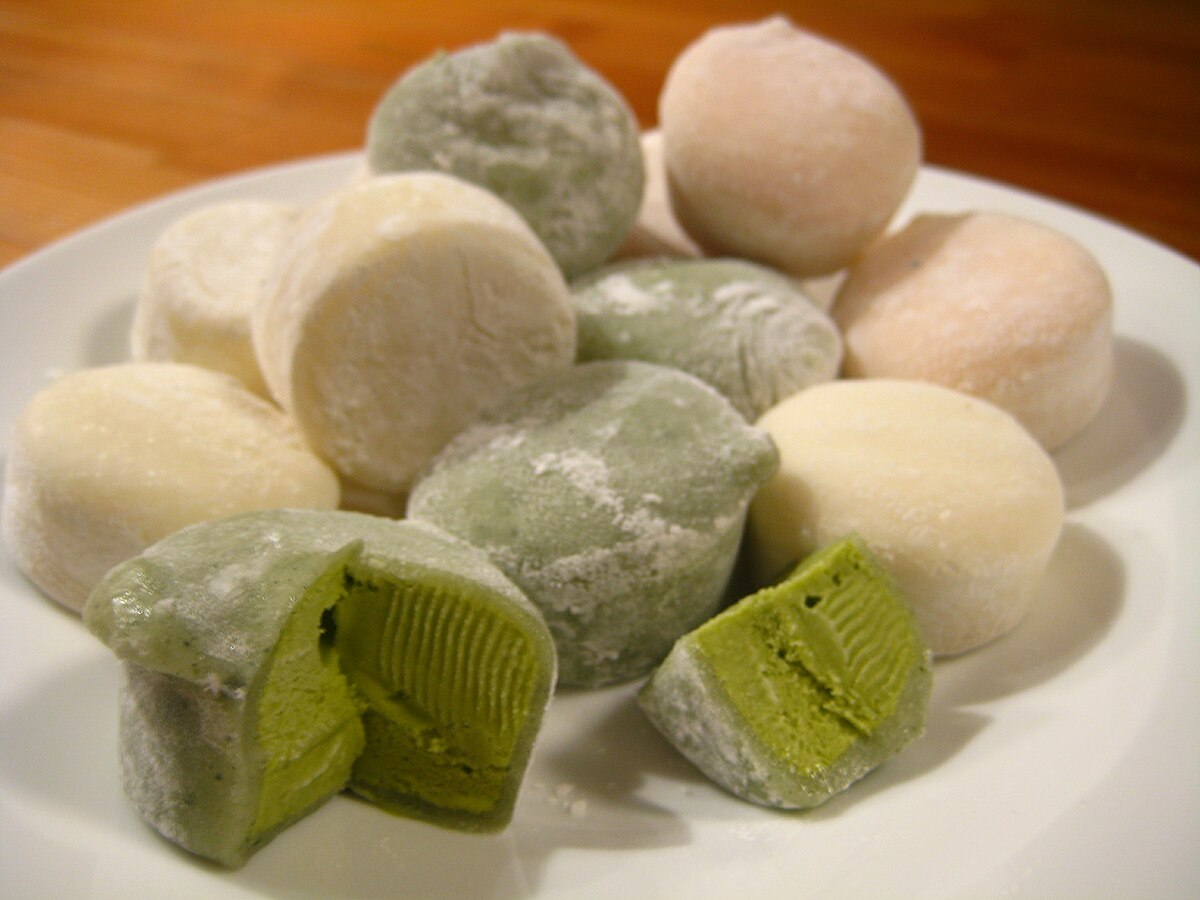
Image result for mochi

Before I tell this next vignette, I have to share a secret, burgeoning desire I’ve harbored for the last several years: I really, really wanted to try mochi ice cream, the sweet cream and rice-cake frozen treat invented in Japan and made popular in the States in recent years. However, as someone who is sensitive to milk and always has been and probably always will be, I assumed that tasting this delight would forever be beyond my reach. Vegan ice cream there may be, but vegan mochi? It seemed unlikely. When I would see freezers of mochi  in the grocery isle and hear them calling my name, I would sadly turn away and inwardly bemoan my dairy-free fate.

So you can imagine my delight when my roommate Jess informed me in passing that not only was there vegan mochi, but it came in GREEN TEA FLAVOR, which was, just as secretly, the flavor I had always wanted to try. So I bought some on my way home, practically bouncing gleefully through the grocery store isles.

After dinner, I opened up the freezer to inaugurate the beginning of a beautiful mochi-filled life and have some for desert. I invited Jess to try one with me, and before we ate, she bumped her mochi to mine as if we were clinking champaign glasses. I took my first bite.

Reader, it was heavenly. It was everything I could ask for and more.

The world is often a frightening, overwhelming place, and we have so much work we are called to do. Small joys like music and mochi cannot change these facts, but they can help gird us through our fallow, restful months and teach us to keep wondering at the world.

Hymn of “I am”

In the spring, I was in a class entitled “Finding Words for Worship” taught by renowned hymnist and liturgist Dr. Ruth Duck.  We were all charged to try our hands at hymn writing, a task that made me profoundly nervous.  What I discovered, however, was that I found deep joy in crafting words to fit a tune.  Below is the hymn I wrote for the class.

Sung to the tune St. Columba (The King of Love my Shepherd Is, United Methodist Hymnal #138).

Based on Jesus’ I Am statements in the Gospel of John (chapters 6, 4, and 15).


I am the bread of life, my friends,

For a hungry world I’m broken.

My life I give to all who hear

And trust the Word I’ve spoken.


I am the well of truth, my friends,

Come taste the living water.

My Spirit will descend on you

And name you son and daughter.


I am the vine of love, my friends,

Your branches will I nourish.

In Love remain and make your home,

In Love will branches flourish.


I am the host who calls you friends:

Receive the meal I’ve given.

My life in you, your life in me

Will bring the feast of heaven.


© Cassidhe Hart, 2015.