In her book The Artist’s Rule: Nurturing Your Creative Soul with Monastic Wisdom, author Christine Valters Painter invites her readers to the traditional monastic practice of praying the hours and offers the suggestion of writing personal liturgies for these prayer times in haiku form. I felt inspired by her prompt and created short pieces for each of the prayer times. Then I put the handwritten pages in a drawer and forgot about them for several years.
Last week, I was cleaning out some items and came across these prayers. I was unexpectedly moved. Obviously these poems meant something to me when I wrote them, but they have retained–and even strengthened–their significance. So I felt inspired to pull them out, edit them, share them, and find a way to incorporate them into my own daily liturgy. The last item on that list is still in progress, but I’m starting by sharing them now. Perhaps you, too, want to compose some haiku liturgies of the hours to accompany you into the new year.
Vigils
 (middle of the night)


Three a.m. again:

Night unfolded and soft,

Dream time, untethered.


All this open time,

Cradled in the Spirit’s hands,

Needs no other bounds.


Lauds
 (dawn)


Praise for the first sound

that tells me I’ve awakened.

Praise for the new breath.


Praise for the dawn light,

whatever its quality.

Praise the resting dark.


Terce
 (mid-morning)


Weary already

And dappled, too, with delight.

Joy comes with the morning


and must be received.

I place my hand on my heart.

Here I make a home.


Sext
 (noon)


Productivity

can never equal my worth.

Slow down and savor.


I move my body

to the dance of God’s great love

that draws me onward.


None
 (mid-afternoon)


Heavy the eyelids—

Grace doesn’t need my focus

to lighten my sight


No matter the length

of shadows or things undone,

Grace refills the cup


Vespers
 (dusk)


Everything can slow:

the heartbeat, the pace of talk

the ring of laughter.


Gather it all in

and let it settle in peace:

Like dew on dry ground.


Compline
 (bedtime)


Where was love present—

especially, tangibly—

in this time and place?


What do I long for—

especially, tangibly—

in this time and place?
Three years since my congregation (and many like it) has held in-person services during Holy Week.
I remember Lent of 2020. I remember people saying things like it was the Lentiest Lent they had ever Lented. And then, it just kept Lenting, kept moving through a season of deprivation and confusion and struggle. Winter came around again, and I never felt properly Eastered or summered or called again into life. We just slogged through.
Last spring, I half-joked that I had given up work for Lent: after several months of illness, I was on a medical leave of absence from my job, and my time off overlapped with Lent. I spent the weeks resting and seeking healing and clarity, and this, too, was a deep observation of Lent.
Easter was still an online celebration that year. Earlier this week I watched a video made by my congregation for last year’s Easter Sunday. Households and members had filmed themselves dancing to one of our Easter songs, and these separate videos were compiled into one, complete music video. It was done well, but watching it left me feeling profoundly sad. We were all so disconnected then – and had been for such a long time. I myself had felt unready to return to my job and the overwhelming stress that was making me ill. When Easter arrived that year, the celebration was muted.
The pandemic isn’t gone, of course, but this year is different. My community is highly vaccinated and knows how to mitigate risk. We’ve been gathering to worship in person for months. We marked Ash Wednesday and each Lenten Sunday together in the meeting house. We practiced our Good Friday music and Easter songs this week, singing them together for the first time in three long years.
My own life is as changed as our corporate one. I’ve started a new job working with local, organic food, and I’ve been writing (joyfully) all the time. My wellness has increased. My stress is manageable. Last year feels as faint as last night’s bizarre dreams.
And Lent – it hasn’t felt very Lenty to me at all.
I’ve felt more Advent-y, honestly. Waiting and wondering and living with anticipation.
I was feeling down about this as Holy Week began, disappointed that my inner life had not lined up with the church calendar, that I had not been able to engage the practice of Lent as deeply as I would have liked. Easter was hurtling close impossibly fast. I thought of the game of hide-and-seek I’d played recently with a three-year-old friend: ready or not, here I come! Holy Week had arrived, and I didn’t feel the least bit ready.
But then I remembered Lent in 2020, Lent in 2021, the long fasting from normalcy that stretched between those Lents, the wrestling with global and personal crisis that had wrung me out. I’d been Lenting, I realized, for a very long time.
We do not observe Lent and celebrate Easter in order to feel particular things at particular times. After all, we celebrated Easter the past two years in the midst of grief and challenge; those feelings didn’t stop it from being Easter. My Advent-like feelings of anticipation haven’t stopped the past six weeks from being Lent. These cycles of observance are not in place to manipulate or dictate our experiences but rather to affirm them, to demonstrate how God and God’s story of love is present in every kind of season. We practice Lent, practice Easter, practice Advent, moving through these parts of the story again and again until they become second nature. We wander Lenten wilderness – God is there. We wait in the pregnant dark of Advent – God is there. We wonder at the cacophonous mystery of Pentecost, soak in the quiet gratitude of Epiphany, mark the days of Ordinary Time – God is there. As we cycle through the story again and again, we learn to trust that birth attends preparation, revelation grows from seeking, and resurrection is not far from loss, because this is who God has promised to be. God’s generative presence does not rely on a careful liturgical performance or a specific alignment of our emotions. Easter comes – ready or not – because the God of life cannot be contained.
Maybe this has been yet another overwhelming Lent for you. There are plenty of reasons for it to be, plenty of suffering and despair, plenty of desert journeys and weapons of empire and sealed-up tombs. Or maybe Lent barely registered, a blip on the map of your year, and Easter seems impossible to contemplate. Whether Lent feels never-ending or far away, Holy Week comes. And we move through the rhythms of fierce and liberating love offered to us in every place, every time, every season we inhabit. Jesus says, “Here I come,” and we are found.
I’ve been trying to find words for over a week now. But sometimes injustice requires imperfect words. There is great harm being done in Palestine, and we perpetuate the harm when we are silent.
There are those who have written expertly on the violence in Israel and Palestine. You can find some of those writings and videos here: a Christian perspective, an introduction from the group Jewish Voice for Peace, and an editorial overview by a Doctor’s Without Border’s member.
(There’s also this video via John Green that gives a historical explanation. I don’t necessarily agree with all his conclusions [and I don’t know why all the people profiles are so visually odd looking], but it was a helpful overview for me.)
I am not an expert. I do not have personal connections to the area. But I do have a profound connection to the situation (perhaps you do, too) because I am a member of a colonial/settler people group. And that means my engagement with the current issue of occupied Palestine must also include a willingness to confront my violent ancestral history.
Some of my ancestors were recent settlers, coming over to the United States to claim the promises of cheap land and new beginnings. But a solid majority of my ancestors were colonizers, arriving four-hundred years ago in what was occupied, conquered, and stolen territory and carving their new lives out of the land and livelihoods of the indigenous people. This is a hard history to face.
Humans have been moving around the planet since we could walk, but migration and colonialism are not the same thing. A colonial project requires an exploitive empire, an assumption of superiority, and a justification for consistent violation of indigenous peoples’ rights (if the indigenous people are acknowledged at all). The place I live has been marked by this oppression and violence, and I live with that inheritance. This is a hard history to claim.
Growing up, I felt such a deep connection to the land I lived on. I felt held by the hills and trees and my time was marked by the way the seasons shifted around me. I experienced a deep sense of belonging, of knowing and being known. The first cracks in this image came with the realization that the fragrant white honeysuckle I was accustomed to enjoying along the edges of a May-blossoming treeline were actually an invasive species. These white honeysuckle had crowded out the native and now hard-to-find pink and red honeysuckle. My sense of feeling at home began to slip. And then other truths about the land emerged: chicory isn’t native, clover isn’t native, I’ve never seen the once-ubiquitous sweetgrass in the wild. I realized that my ancestors came not only as impoverished people fleeing to something new, but they also came as conquerors, inflicting the oppression they had received on the natives they refused to recognize as equals. I had to face my own invasive-ness as well as the realization that I wasn’t sure I knew my native land at all. This is a hard past to internalize.
I suspect that one reason we American are often silent on oppression in Palestine is because we see the resonances with our own history. Truly seeing is painful. It dredges up feelings of confusion and guilt. It requires an admission of wrong. But if I am willing to stay with my own colonial narrative long enough, a new possibility emerges.
I can’t change the past. I can’t undo every action my ancestors took to trick, coerce, and kill the people already present on this land. I can’t retract the harmful British colonial policies that created the current situation in Israel and Palestine. But I can choose to encounter the past with integrity. I have the power to own my place in a lineage of destruction that I did not create but still benefit from. I am free to name the recurrent themes of settler colonialism around the world – and still present in my own country – and to amplify the voices of those seeking liberation. And, with enough work, I can choose to transform the trauma my people endured and then inflicted into solidarity with the oppressed.
This inner liberation must go hand-in-hand with the outer work of seeking justice and peace in places like Palestine. If we choose to look together into the harmful narratives we have inherited, we can take the first steps to writing a new story of freedom.
I don’t remember why, but I was reading the story of Samuel and his mother Hannah in the book of 1st Samuel, and I was struck by a phrase that recurred several times: “the word of the Lord was rare in those days.” So I decided to write some song lyrics inspired by my meditation on the story.
1.
The word of God was quiet then,
and visions weren’t so widely known.
Prayers were made by violent men,
who claimed the Holy as their own,

When Hannah came to Shiloh’s heights
and fell upon its sacred ground.
She poured her offering of tears,
mouthing words without a sound.

“Don’t forget me, Holy One,
don’t ignore my desperate cry.
If we can’t hear you, are you listening?
Do you hear each anguished ‘why’?”

2.
The word of God was quiet then,
and visions weren’t so widely known,
so Hannah left and looked for hope
all along the journey home.

An answer swelled within her womb,
a promise grew into her son.
When he was weaned, she brought him back
in thanks for all the Lord had done.

“I remember, Holy One,
how you listened to my cry.”
Hannah turned her prayer to song
and lifted praise to Adonai:

3.
(The word of God was quiet then,
and visions weren’t so widely known.)
“My heart rejoices in the Lord.”
She sang, “My strength’s in God alone.”

“The mighty warrior’s bow has snapped;
the stumbling ones are clothed in pow’r.
The barren woman rocks her child;
the hungry feast on manna shower.

“You remember, Holy One,
and you listen to our cry.
Before I questioned, you were listening,
Before I asked, you gave reply.”

4.
The word of God was quiet then,
and visions weren’t so widely known,
but Hannah sang with joyful faith
and nurtured seeds of hope she’d sown.

Did her son, the prophet Samuel,
learn from her what listening means?
Were the words of God so silent?
Whose holy visions were unseen?

We remember, Holy One:
We must learn to hear your cry,
not in those who grasp at power,
but in the outcast asking why.
While it was still dark
we grabbed our cups of warm beverages
and set off down the nearly-empty street,
the watchful eye of the half-moon
looking out from the sky growing bluer every moment.

Everyone on the beach is a silhouette,
recognition made harder by the masks we wear.
But somehow we know each other by the choice to be present
here
in the cold dawn on the colder sand.

The singing starts.
It’s more muffled this year,
but not even thirteen months of pandemic
will silence us altogether.

We watch the horizon
where a band of cloud
meets the placid water,
and I wonder
what we’ll actually be able to see this year.

We sing the sky to brightness,
and the first streaks of color break through:
jagged lines,
like stretch marks
where the whole world has been waiting to give birth
to this particular morning
in this particular place
with these particular people shouting
“Alleluia!”

And indeed the sun does crown the cloudy horizon.
And a child marvels at just how big it is.
And the lake reflects the glowing red
into a path of light,
a pillar of fire guiding the way
into liberation.
Death has lost its sting,
and God has arisen
in the swimming muskrat
and the calling seagulls
and the little boys gleefully kicking sand
as the round stone of the sun rolls higher into the sky,
as the pillar of fire grows too bright to look at
and sinks slowly into the water
where it becomes the promised land.
I wrote this hymn during the season of Advent this past year because I longed for new lyrics to the familiar carol “God Rest Ye Merry, Gentlemen.” But this song also is appropriate for March 25, the Feast of the Annunciation, the day we celebrate the angel’s visit to Mary and Mary’s perplexed but wholehearted ‘yes.’ I was inspired both by Mary’s own song and by St. Basil’s ancient words: “Annunciations are frequent; incarnations are rare.” What seeks to be made alive in you today?
The angel came to Mary with the message, “Do not fear!
You are the highly favored one, and God is with you here,
For you will bear the Son of God and bring God’s kingdom near!”
O, tidings of comfort and joy, comfort and joy! O, tidings of comfort and joy!
When Mary heard the angel’s words, she asked, “How can this be?”
The angel opened up to her the sacred mystery,
And even then her longing grew for all to be set free.
O, tidings of wonder and joy, wonder and joy! O, tidings of wonder and joy!
And Mary told the angel, “Here I am to serve the Lord.
I will receive God’s promises according to your word.”
And she prepared her heart to hold the Spirit then out-poured.
O, tidings of mercy and joy, mercy and joy! O, tidings of mercy and joy!
Then Mary raised her voice to God in hopeful, thankful song:
“God has begun the turning we have waited for so long:
Redemption comes to lift the weak and to reshape the strong!
O, tidings of justice and joy, justice and joy! O, tidings of justice and joy!”
The angel comes to each of us, invites us all to bear
God’s love made flesh within our lives. So let your hearts prepare!
Will Mary’s yes take root in us and grow until we share
God’s tidings of comfort and joy, comfort and joy? God’s tidings of comfort and joy!
I did some very serious pillow punching this morning, hoping that my daily ritual of anger expression would somehow cleanse me of my tangle of emotions.
It did not.
Anger is everywhere I look: in the images of the crowds storming the US capitol, in the Facebook post reactions, in my own frozen, frightened body. And though I want to understand its power as a tool, so often anger paralyzes me. Whether your anger feels like a controlling force or a numbing drug, it can be utterly overwhelming.
I’ve been told that anger is a gift – a propelling fire of righteous anger can fuel our movement toward justice. So I began wondering: how do I transform my anger into action? How do I let my fear and my indignation move through me and prepare me for the loving work that comes next in dismantling white supremacy?
Last night, as I considered the stress of this moment in our nation and of the whole past year in general, I shared with my sister something I’d learned about zebras in the wild. After a zebra has survived a predator’s attempt to chase, kill, and eat her, there is a mighty amount of residual adrenaline coursing through her body. So the zebra shakes – shakes and shakes and shakes every muscle until the trauma of the recent encounter has been digested by each cell. The zebra doesn’t shake off the stress – she shakes through it.
This afternoon, after a Zoom call with colleagues and students at the school where I work in which we processed yesterday’s events together, I went into my room and created this ritual space for myself:
I closed the door. I looked to my window. And I began to shake my whole body.
I shook my arms, my head, my legs – I tried to get every muscle involved.
As I did so, I opened myself up to the fear and the anger I’d been trying to hold inside, and I let it shake around in the pit of my stomach. I named that fear and that anger to myself again and again. It almost felt like too much.
Eventually, I was spent, out of breath. I sat down in my chair, breathing hard, still letting myself experience the fullness of my emotions.
Once I caught my breath, I began to repeat an affirmation to myself. “I am not alone,” is what came to mind. I repeated the phrase with each deep breath in and out.
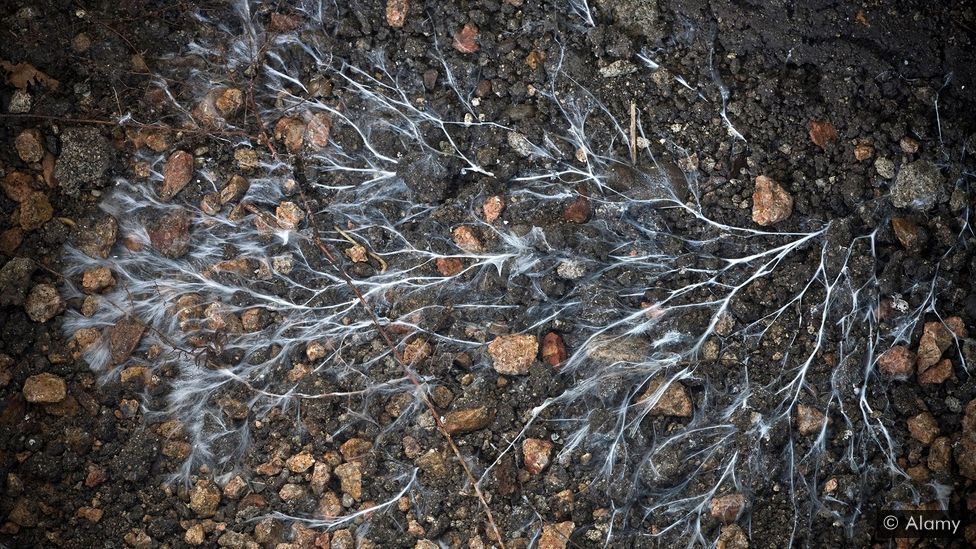
As my breathing began to slow, I imagined threads connecting me to each person around me, to the earth beneath my feet, to my loved ones far away. The imagined shape began to resemble the mycelium networks that burrow through every inch of forest soil, connecting tree to tree. I let that image feel as real as possible. I considered if this is what the Holy Spirit is like.
I wondered if there is an affirmation for us, together, not just for me. “We are grounded,” I said to myself, considering this web I held in my mind’s eye. And I felt my heartbeat slow. “We are grounded.”
And then I asked if the Holy Spirit had a call or a summons for us in that moment. I felt the pull to root myself deeply in that connection I’d experienced. So I kept breathing into it.
Shake, feel, breathe, center, connect, listen – I plan to go through these steps as many times as needed in the days and weeks ahead. I am often so afraid of my anger becoming destructive that I never tap into the strength of its holy fire.
We will need a lot of holy fire as we continue the work of growing just communities. So I invite you zebra-shake with me, shake through your anger, and let yourself be grounded in the truth of our connection.
My fellow white siblings, those who are seeking to root out racism, this is for you.
Maybe you’ve been engaged in anti-racist work for a long time. Maybe you have recently begun. No matter where you are in this life-long process, there is significant emotional work for white people to do as anti-racists, particularly at this time in our nation’s life. But as Jennifer Loubriel explains in this article, there are helpful and harmful ways to process our emotions; when we ask Black Americans to reveal our harmful habits or perform our emotional labor or carry our burdens, we perpetuate racial injustice. We need to know when to be silent.
At the same time, the legacy of white supremacy leaves us with little experience of healthy emotional expression. White supremacy, as a constructed system of thinking and behaving, has long privileged the mind over body and feeling and has denigrated outward expressions of emotional overwhelm. Don’t be sissy; hold up; keep a stiff upper lip; stop being hysterical; be rational; calm down–these are the messages we have internalized. I still learn everyday how to acknowledge and lean into my emotions. I haven’t had a lot of examples on how to do so, but I have seen the stunting, life-draining effects of shutting off and shutting down my emotional experience. We are bound to have a lot of feelings about racial injustice, white supremacy, and our own complicity. We need to know when to express our feelings.
And we also need to know how. The article linked above has some good tips on the when. So, my siblings, let’s talk about the supremely important “how.” I don’t pretend to have all the answers, but here are some ideas to get us started.
Regular Emotional Practice
At the beginning of the year, I shared how I had developed a regular practice of expressing anger by setting an intention before I punched my bed pillows back into shape each morning. I’ve been grateful for this habit in our current stretched out season of plenty to be angry about; making a practice of anger means that I am learning how let my emotions move through me, how to let the anger rise and fall, how to trust that it will not consume me. Our culture labels emotions as “positive” and “negative,” but emotions don’t carry moral weight. They are neutral. And after years of suppressing them, it can be helpful to practice feeling them in ways that feel safe. Anger is one of my most difficult emotions, but perhaps yours is something else. What feelings have you been resisting or confused by as you’ve watched the news or learned about racism? Maybe you need to paint your sadness or wail your grief or break things in disappointment. Notice what emotion needs practice, and then discover a healthy, held way to embody it.
Finding Partners
One thing Loubriel suggests is having a cohort of fellow anti-racist white folks to process with on a regular basis. We absolutely must connect across race and ethnicity, but we also need places where we can ask questions or process ideas that could be harmful to folks of color. Groups like this can take a variety of shapes. I know that my housemates, who are white, are loving, supportive, justice-seeking folks learning to interrogate their own privilege, and we can hold each other accountable. There are white folks in my worshiping community and my workplace who also challenge me and strengthen me and seek to live out anti-racist principles. I need the encouragement of all these folks to continue this counter-cultural work and face again and again the racism within myself.
Who are your partners? If you don’t have them, how can you find them? If you haven’t been able to find people nearby (or are simply dealing with the limits of pandemic social distancing), one online place you can check out is the community of folks at Energetic Justice.
Truth Mandala
During a workshop with Joanna Macy’s Work That Reconnects, I encountered a ritual called the truth mandala. Go ahead and click that link–this is a moving practice of communal expression and particularly well-suited to the kinds of groups mentioned above. Engaging this practice with a group of people is not always an option, however, especially in our current pandemic experience. So here is how one might bring the wisdom of the truth mandala to a personal practice.
Gather objects that have emotional resonance for you. In the truth mandala as described above, there is a stick for anger, a stone for fear, dry leaves for sorrow, and an unfilled bowl for emptiness. Whatever objects you choose, you should be able to hold and handle them, connecting your body to the experience of your emotion.
Create a time and place where you will be uninterrupted. Set out your objects, and set aside all distractions: phone, computer, chores, books, to-do lists.
Take several deep breaths. Notice where your body has tension. Notice the quality of your natural breathing. If you’re already feeling somewhat connected to your emotions, simply notice what emotions arise.
If you’re feeling stuck in your head or unsure of how to connect to what you’ve been feeling, let your mind wander through the last several days and weeks and all we have witnessed. When have you wanted to look away? What images stick out to you? Where have you felt resistance or defensiveness? Sit with these memories and breathe through them, and welcome in whatever feelings come.
Consider which of your chosen objects best represents the emotions you are experiencing. As you engage with the object, try speaking your feelings aloud. Don’t be afraid to voice feelings you feel ashamed of or to express confusion and contradiction. Release the need to judge or edit your emotional expression and simply sit with yourself.
Give yourself a little more time than feels comfortable–stretch your limits a bit. When you feel like your expression has come to a close for now, do something that feels cleansing or hospitable to your body: take a bath, take a walk, drink a cup of tea, massage your hands, shake your limbs, dance to music.
Writing Practices
I’m a little biased in favor of journaling as a practice of emotional release, as its something I’ve been doing for about two decades. Because I’m someone who is both an external processor and an introvert, journaling has been an invaluable practice contributing to my overall wellbeing. If you’re looking for specific prompts related to racial justice, this document contains some helpful questions towards the end (as well as a host of other resources).
Some writing practices I’m hoping to engage in the next couple weeks are writing letters: one to my ancestors and one to my descendants (or simply those who come after). In the letter to ancestors, you might consider these questions:
What do you wish you could ask your ancestors?
What legacies leave you feeling guilt and shame?
What do you wish you could tell them about the present?
In a letter to future generations, you might consider:
What do you want to confess about your current experience?
What legacies do you hope to leave?
What kind of world are you working for?
Other practices
Find a song that resonates with you–or better yet, a whole album. Dance to the song(s), letting your body’s movements enact what you’re feeling in this current moment.
Sing–learn the words of songs that inspire you. For me, that’s songs like MaMuse’s We Shall Be Known, Ella’s Song sung by Sweet Honey in the Rock, and The Kingdom of God from the Community of Taizé. Learn the lyrics of your own meaningful songs and sing them when you don’t have words of your own.
Admit when you’ve made a mistake–confession is healing for the soul and releases us from guilt. Not a single one of us will ever be a perfect anti-racist ally and accomplice. Confess your missteps (aloud is best!), open yourself to grace, and try again.
Anti-racism is a life-long commitment, and reconnecting with our emotions is ever-deepening work. Engaging in both opens us up to justice and joy in ways we could never imagine, and we are liberated to be fueled rather than hindered by all we feel.
If you do enough reading about Christian spiritual practices, you will inevitably come across writers waxing rapturous about about the daily discipline of reading and praying the Psalms. I’d been skeptical. There were some psalms, it was true, that resonated with me. Psalm 42 has been a favorite for decades. More than once I had turned to the Psalms in times of danger and found comfort there. But it was hard for me to imagine praying these often strange songs day-in and day-out.
I can’t remember what prompted me, but I finally decided to give it a try, reading 5 psalms each day for a month; there are 150 Psalms, so if you read 5 each day, you cycle through them all in a 30-day period. Much to my surprise, I kept to this practice for several months. In doing so, I discovered several aspects of this practice helped me connect best to this ancient prayer book.
First: I read them aloud. The Psalms are songs, written for public worship and expressive reading or singing. Reading a psalm to myself in my head was not easy to focus on, and I would feel my attention slipping, but reading them aloud highlighted the poetry and vibrancy of the language. It forced me to slow down, to contemplate the words, to let them find a place in the world. Sometimes my voice was barely a whisper, but the simple act of breathing the words gave them life.
Second: volume matters. I read 5 psalms every night before I went to bed. I didn’t get to skip any of them (not even the interminably long Psalm 119). Reading a greater number of psalms each day took the pressure off each chapter or verse; I knew that I would be moving through various emotions and experiences in each reading, and it was highly unlikely I would empathize with them all. So I stopped worrying about their emotional resonance and knew that, at some point, I would come across a phrase that felt like an earnest prayer. The rest didn’t have to be my prayer.
Which leads me to my third lesson: praying from the margins. Dietrich Bonhoeffer wrote that, when praying the Psalms, we can think of ourselves as joining our prayers to Christ, who prays them, too. I also imagined joining my voice to those who are in distress. When I was in Sierra Leone for several weeks as a teenager, a neighbor began trying to peek into our windows at night, and it was was terrifying. I remember sitting under my mosquito net one night, trying to calm my breathing, reading psalms about deliverance from enemies that I had never really connected to before. Outside this experience, I haven’t felt I needed those enemy psalms. However, when I began my Psalm-reading practice, it was month or so into President Trump’s new administration, and harm against immigrants was ramping up every week. So I imagined frightened families on the border calling out to God for rescue, and I tied my reading to their prayers. So many of these psalms suddenly became relevant, words I knew siblings across the globe were crying out in some way. Praying the Psalms was not about me. It was a way pray with God’s children pushed to the edges of world.
Fourth: repeat the cycle. By starting over again at Psalm 1 when I finished Psalm 150, my prayers took on the shape of a circle rather than a line. My evening prayers were not about reaching a particular destination but about relating to God and to the communion of saints in widely varying circumstances: praise, confusion, assurance, fear, hope. And then coming back to those places again, knowing that each was a part of the human experience. The Psalms and their language became familiar. I would sometimes find myself structuring my spontaneous prayer throughout the day in very psalm-y ways. These songs became a part of me, not simply words I read. Sometimes now I will read through just one psalm before going to bed, and it feels like the entirety of the collection is then invoked in me.
I continue to be surprised by how much this practice has changed my relationship to the Book of Psalms, to scripture in general, and to prayer itself. Perhaps you, too, have felt curious about praying the Psalms – if so, take whatever from these observations feels helpful and discover what your own practice looks like.


 cassidhe hart