When we know where the fire burns

Due to the peculiar nature of layovers, my flight back to Chicago from Southern Oregon took me through Los Angeles. As we flew over the California coast, I saw billows of smoke rising into the air—evidence of the wildfires tearing their way across the dry ground. I was sad, even disturbed, by these fires; they poked at my desperate feelings about climate change and environmental preservation. But I was removed from them in every possible way, soaring miles above in a machine that only added fuel to the fire of the climate crisis.

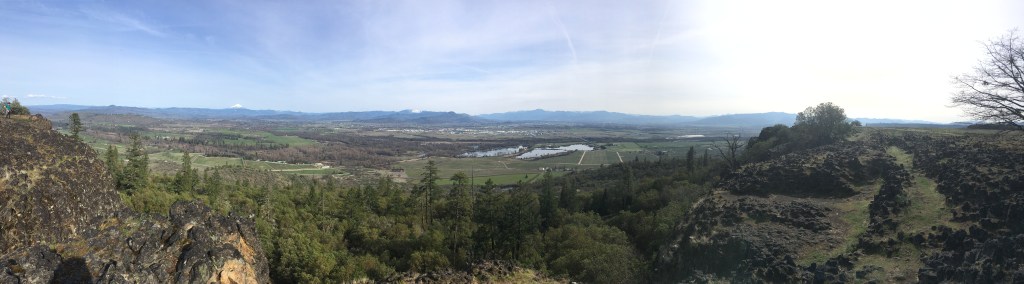
Instead, my mind was on Oregon and the beautiful Rogue River Valley I’d left behind. I had been there for a storytelling training, once in March to begin and once in October to close out. The place had captivated me—three mountain ranges joined and merged at this valley, filling the horizon with sharp blue shadows. The terrain—the climate, even—varied depending on what side of the mountain you stood on, or how far up you were. I explored mossy creek gullies and snow-capped peaks, drove down winding roads through oak savannas and sat in quiet pine forests. I hiked up volcanic landscapes and watched the valley spread out beneath me. I loved the way the topography was open enough to be a like a map—I could see each landmark no matter where I was, miles and miles away, and hold the shape of the valley in my mind.

At night, I watched the mountain shadows fall over the pastures and vineyards, and I breathed in the smell of wood smoke. In the morning, I cut up pears grown nearby and saw the sun move over the Cascades. This place brought me such deep peace and gratitude.

Almost a year has passed since that trip, and we’ve circled back around to wildfire season again. I’ve watched with pity as the skies across Washington and California fill with smoke. I’ve wondered how long it will be before we finally take climate change and it’s exacerbating effects seriously. And then, this week, I saw the news on my facebook feed, echoed by the many friends I’d made in Oregon: the Rogue River Valley was burning. The fire was un-contained. The wind was whipping the flames past the farm I’d stayed at during both visits. A colleague’s house was burning down.

Pain filled my stomach. The images of towering flames caught my breath. I felt like I wanted to throw up. Helplessly, I listened to a live video as the firefighters named roads I knew and prepared to evacuate whole communities. In my mind’s eye, I could trace the path of the fire as it devoured that beautiful place. I cried. I railed. I was no longer in an airplane looking down at a distressed but unfamiliar landscape. I was all but choking on the ash made up from a place I loved.

We cannot save the world in the abstract. That’s not how we humans work. The word “courage” comes from the word “heart,” and we fight most fiercely for what we love. The magnitude of the ecological crisis we face—climate change, species loss, ocean acidification, melting glaciers, fiercer storms, degraded soil—it’s all too much. One brain cannot face the enormity of it all and still have the power to act.

So, instead, we must let little pieces of the miraculous world God so loves into our own unfathomable hearts. And it is then we witness how God’s own passion blazes within us, ready to travel through overwhelming grief and impossible odds to show us just how much we love the world, too. We feel our kinship with some small space on the planet, and we grow a determination to help that place flourish.

I can’t stop the fires scorching the beautiful Oregon valley that has captured my heart. Not a single one of us can clean up the whole ocean or reduce carbon emissions enough to make a difference. But because I have opened wide my heart to the love of God present in some small patch of God’s good creation, I will find the courage to love the earth well. To protect the places that bring me delight. To cultivate the imagination needed to envision new systems of energy and commerce. To re-align my rhythms with that of the place I call home. Even to let go of the possibility of ever visiting Oregon again, if that’s what it takes to protect what I love. If we are driven by fear, we will fail. When we are driven by love, that’s when miracles happen.

The change we seek won’t happen overnight, but, spurred by love and sought together, it will grow like fresh new plants after a forest fire—resilient and ready and bursting with hope.

“No, you may not hold my hand, Philip!” And Other Things I Was Too Afraid to Say (Or #YesAllWomen, #NotOkay, and #MeToo)

Phrase #1 “Those boys are bothering me.”

When I was in 1st grade, I rode a county bus that picked up students from kindergarten to 12th grade. My seat was the third on the left, and I shared it with my friend Staci. At some point during the year, some troublemaker middle-schoolers were moved to the very front seat where our bus driver could keep an eye on them. Because of the mirror directly above the driver’s seat, these boys could also keep an eye on me, and, though I’m not entirely sure why, they decided that their newest diversion would be tormenting me from several seats ahead. “Little girl, little girl …” they would begin in mock-high voices as soon as I had claimed my seat on the bus, ogling at me through the mirror. “Look in the mirror, little girl.” I suppose they wanted me to look in the mirror because it was, under the observation of the bus driver, the only way they could exert their control and superiority over me. To this day, I wish I had cheesily smiled up at them through the mirror and then shrugged—that I had somehow shown that they didn’t have the power to make me feel small. But they did have that power. Instead, I hung my head and stared at my feet, refusing to look even remotely in the mirror’s direction. The bus driver asked me once if they were bothering me, but I didn’t want to be a problem. And if she had to ask, I wasn’t sure she could understand just how much they were bothering me.

Each day, Staci would join me in my seat, I’d mumble to her, “They’re doing it again,” and be grateful for her company. I never told anyone but Staci about it. For some reason I felt embarrassed and guilty about their behavior, as if I was the cause, not the victim.   Until the bus driver finally moved them again, I truly felt like a very small, very powerless “little girl.”

Phrase #2 “You are very kind, but I’ve really spent about as much time with you as I can manage.”

It was my freshman year of college, my first year of adulthood, and my first real foray into the world of dates and rejecting them properly. I can’t be sure Jeremiah was asking me out, but I do believe he was trying. I don’t remember if this was before or after the time he awkwardly stood in my room engaging me in conversation while I waited for him to leave, or before or after the time I literally had to kick him out of my room because it was past dorm visiting hours. But he asked to eat dinner with me, and I told him that I was busy that night—instead of, as was called for in each situation, saying, “You really are very kind, but you can’t take a hint. I’m done now. I’ve really spent about as much time with you as I can manage. Please leave me alone.” He meant no harm, but his obliviousness to my body language and even my verbal language erased my own desires, and if he didn’t understand these boundaries, what other boundaries could he cross? I was afraid that outright rejection would leave me exposed. So I gave an excuse and hoped he wouldn’t feel cheated out of something I owed him.

Phrase #3 “You think you’re being clever, but actually you are living into a misogynist narrative that does not become you.”

I was writing a paper—probably for my Philosophy of Gender class—about the stereotype of the over-emotional woman or some similar thing. I first decided to write the paper because of an exchange with a male friend in which, after expressing incredulity that I get in bad moods, he said finally, “Oh, well, of course you have bad moods; you’re a woman.” That, it seemed, explained everything.

Whenever I brought up the paper topic with my male friends, they would typically respond with a quip like, “the stereotype?!?” Of course implying that the over-emotional woman was no stereotype at all but verifiable fact. I would simply grimace and move on, but I used their responses as fodder for my paper. It was always disconcerting, though; my otherwise kind, enlightened, respectful male friends had no difficulty perpetuating the idea that women are more emotional than men and that this emotion is something problematic. I felt angry and dismissed, but also sad. They were stunting me, yes, but also themselves.

Phrase #4 “Our mutual existence in physical space does not give you ownership over my body!!!!”

So I probably wouldn’t have shouted that exact phrase. And perhaps it should have been expletive-laden for extra effect.

I was in Berlin, slightly jet-lagged and mildly culture-shocked, walking down a sidewalk at dusk. My two female companions and I were attempting to take up only the polite amount of sidewalk, but it was difficult with the myriad outdoor seating, recycling bins, and ornamental trees that shared the walkways. Some young men came whizzing from behind on their bikes, passing us on the left. One of them reached out and slapped my rear as he sped by. I didn’t say anything—not to the swiftly speeding boys, not to my companions, not to anyone, ever. I immediately assumed that I had been in the wrong in some way—that I’d been taking up too much of the sidewalk or walking on the wrong side. Somehow I convinced myself that my actions gave a random stranger the right to touch me. Even if I had been doing something problematic, which I wasn’t (sidewalks are for walking and roads are for biking, friends), my body and the space it inhabits is still my own. I wasn’t the one transgressing boundaries—the young man was. But it’s taken me a decade to come to that conclusion; so many other voices suggested otherwise.

Phrase #5 “No, you may not hold my hand, Philip!”

I was once again in Europe, this time in Paris, taking in the sights on a solo journey. One sunny afternoon, I walked down the Champs Elysee toward the Louvre, intent on getting in line for the museum’s weekly free evening. As I shuffled up a pair of steps, someone spoke to me, in French, and I responded, in my best but broken French, that I did not, in fact, speak French. The gentleman then switched to English, asking an innocuous question about where I had gotten my shoes. It seemed like such an innocent and normal question, and the conversation that followed was in the same normal-sounding vein.

It wasn’t until we got closer to the Louvre that things began to feel “off” with my new acquaintance Philip. His questions were more prying, his tone was more insistent. He invited me to come with him on a tour of the city. Internally I said, “Hell, no,” and externally I politely declined. He was persistent, saying I could go the Louvre any old time. I told him I really needed to get in line. He said it was much too early—the museum didn’t open for an hour. I didn’t know how to argue with him; I hadn’t learned how to say phrase #2 yet. For some reason, not offending him was more important than my wellbeing—or, perhaps, not offending him seemed paramount to my wellbeing. I finally agreed to sit with him on a bench in a nearby public courtyard until it was closer to opening time.

As we walked past the growing, snaking line, he grabbed my hand. Everything in me froze; I didn’t want to hold his hand. I didn’t even want to be talking with him. I didn’t want him anywhere near me. But something inside me was paralyzed. Instead of saying “no,” or forcefully—or even gently—extracting my hand, I felt I needed to justify my movement somehow. So I pulled my hand away to open my water bottle. I then kept my hands on my purse.

After we sat on the bench, his sentences and body language became halting, unsure, agitated. He talked for 20 minutes straight about everything and the kitchen sink. I nodded along and tried to summon up the courage to interrupt him. Finally, I told him that it had been lovely talking with him, but I really had to get in that line. He hung his head and said I must not have enjoyed myself if I wanted to leave. I don’t know if he bought my lies, but I had finally had enough. The frustration that might have propelled me to yell out, “You may not hold my hand, Philip!” won out over the politeness that had silently withdrawn my hand, and I said and abrupt goodbye and walked swiftly back the Louvre. My common sense had kept me from doing anything dangerous, but my fear of upsetting Philip kept me from living into my own agency. It felt like a living example of the phrase, “Men are afraid women will laugh at them. Women are afraid that men will kill them.”

Phrase #6 “Why don’t you respect my own authority?”

I got on a Chicago city bus with two other young women connected to the campus ministry I was working for. We sat near the back where there were more seats since we were waiting for two young men to join us. A man we did not know came to the back of the bus and sat among us. He asked us if we had anything to eat and then laughed. He tried to engage us all in rather condescending conversation—we all felt uncomfortable. I rolled my eyes at one of my companions, but I didn’t ask him to leave. I didn’t know what he would do if we asked him to leave.

Finally, our male friends joined us, coming to the back section of seats. The creepy man immediately jumped up and said, “Oh, I didn’t know you were with them.” In his mind, he now saw that we were already claimed by a man, and, because of that other man’s presence, creepy man now had no right to be there. I felt both demeaned and livid. And though I was glad the creepy man left us alone, I wanted him to respect us for ourselves, not for any supposed male authority over us.

Phrase #7 “Stop!”

I actually did say this one.

I was in the Grand Bazaar in Turkey, and we had to enter a tremendous press of people to get through to the other side of the street. It was a pedestrian traffic jam such as I have never seen. Bodies pressed against bodies, everyone trying to push their way through, a whole seething mess of humanity. Suddenly, one of my female travel companions came up to me and said, “Someone just groped my breast.” Her eyes were wide and terrified. I pulled her under my arm and tried to push through faster. Then I felt someone grab and squeeze my own rear end. I whirled around and pushed the person directly behind me. “Stop!” I yelled, not caring if this person spoke English. My tone would speak for me. He didn’t respond in any way, didn’t look at me, just stared at the ground. I was shaking. And I didn’t stop shaking all day.

As a group that night, we all sat together in one of our rooms and talked about what had happened. We talked about sexual assault and sexism, and I felt better for the conversation and discussion. Holding things in had made me feel less vulnerable initially, but sharing the experience eventually made me feel held in my pain and righteous in my anger.

~~~

I am not a timid person. I’ve been told more times than I can count that I am confident, even sometimes intimidating. My parents taught me that being female did not change what I could and could not do. I have surrounded myself with strong, loving, and encouraging people. I generally feel powerful enough to make choices that ensure my own safety. But somehow, in the midst of all this, I absorbed the cultural messages which said that any discomfort, pain, or embarrassment I experience at the hands of a man is my own fault, that to speak up for my own desires is to be too abrasive, and that a man’s agency is more important than my own. I have learned to keep silent, to keep the peace, to keep a man’s pride intact. I have learned to be afraid of using my voice.

I refuse to be afraid any longer. Some of these instances were minor. Some feel more pressing. None were life threatening, at least not in the traditional sense. But all of them threaten my life in that they each contain a moment when my existence was deemed less valuable because it was a female existence. Each experience on its own might not add up to much. But put together, along with countless other micro- and macro-aggressions against women, these moments threaten to silence and dehumanize me. I wish that I had been empowered to speak each of these phrases when the occasion called, but it is my choice now to speak up and speak loudly, until every woman’s voice is freed and heard.

Water is Life

I got this swooping, sinking, rushing feeling when I saw my professor’s facebook post.  He was planning to answer the call for clergy to come to Standing Rock next week, he said.  And would any students like to join him.

I didn’t really want to go.  I knew what camping in the freezing cold was like.  I’d seen the videos of violence against protesters.  I had a full schedule in the week ahead.  And I felt woefully unprepared.  But something deeper than desire and stronger than fear rose up within me and whispered, “Go!”

So I emailed my various supervisors and professors and asked if arrangements could be made for me to miss 4 days of work and classes, a not-insignificant part of me hoping they would say “no.”  But they didn’t.  They told me that this was an important opportunity and that they would make things work.  And the whisper inside me grew bolder and said, “Go.”

I decided to sleep on it and pray for guidance and had a very distressing but unhelpful dream about biking across Europe in the autumn and falling over on 3 person a bicycle into a mud pit.  The morning found me both weary and wired.  And the voice raised itself up inside me and shouted, “Go!” I knew that if I silenced that voice, I would silence something essential in me.  Call it my conscience, my vocation, a sense of justice, the Holy Spirit living in me – more than I wanted to stay home, I wanted to listen to that call and stand with those who needed allies.

There are several camps now at Standing Rock, all working toward the same purpose: halt the death-dealing black snake of the Dakota Access Pipeline.  This pipeline and the oil it carries represents disregard for native lives and well-being, a threat to water sources, and a victory for big oil companies rather than a move toward sustainable energy solutions.  The Water Protectors (the preferred term, rather than protesters) have been using non-violent forms of resistance to call attention to the unjust and unethical practices of the pipeline construction.

This past week, a call was made to clergy all over the nation to join the Water Protectors at Standing Rock and stand in solidarity.  This is a crucial time for the work against the pipeline.  Violence and force from law enforcement is increasing, winter weather is beginning to set in, and the tribes gathered at Standing Rock need our support.

I am going with 11 other Garrett-Evangelical students, professors, and alums, as well as 2 non-seminary-affiliated folks.  We’re joining clergy and people of faith and people of no faith from all over the country to stand with those at Standing Rock.  We’ll be leaving Tuesday, arriving in Cannonball, North Dakota, on Wednesday, and participating in the clergy solidarity action on Thursday.  We’ll make the long trek back on Friday.  We ask for your prayers for strength, wisdom, peace, and justice.

ict_editoon_090416

Behind that tiny word “Go!” are so many convictions that God has grown in me over the years:

  • God made the world and made it good (Gen. 1)
  • God includes the whole earth in God’s vision for community and justice (Lev. 25, Isaiah 11)
  • In the incarnation, Jesus was born, lived, died, and resurrected as a human, fleshy body who walked on this physical earth – in the incarnation, God affirms the goodness of Creation and brings the whole world into the redemption story (John 1, Romans 8).
  • All of Creation will be made whole (Romans 8, Isaiah 65).
  • Our God is One of justice and mercy, and God stands with the oppressed and the marginalized (Matthew 25, Luke 18, Isaiah 1 and 58).

I go to Standing Rock because of the God I serve and the kingdom of God that I am called to join.  I ask you to join your hearts and prayers to mine, and together we will work for the good of all God’s people and land.

More information from those on the ground about the history and situation:

http://standwithstandingrock.net/history/

This article is a couple months old, but it gives good background information:

http://indiancountrytodaymedianetwork.com/2016/09/26/sierra-club-no-dapl

If you have very warm winter gear – coats, boots, tents, sleeping bags, etc. – or hygiene items that you want to send with me, let me know.  Here are other ways to help:

http://act.350.org/sign/stop-dakota-access-pipeline?akid=s197373..Z7kCFf

Finally, you may be thinking, “This sounds like a good cause and all, but doesn’t it defeat the purpose to use a lot of oil/gas and drive out there?”  Good question!  We still live in an oil-based economy, and there just aren’t a lot of good options for traveling without using petroleum.  This is in large part due to the subsidies oil companies receive and the huge amounts of money and political power our nation grants them.  If enough of us can stand up and say NO to the Dakota Access Pipeline, then we may be able to have enough people power to imagine and enact new, healthy, sustainable and just ways of being a society.


Two days after a homecoming

It seems to me that there is a lot of information out there about culture shock and a traveller adjusting to foreign cultures, but I haven’t heard a lot of stories about people when they come home.  Perhaps that’s because all the stories are comparatively less exciting and, well, less foreign, but I think ending the sojourner’s story with the flight home is akin to ending a meal before all the silverware has been used: there’s something missing.  It’s not a truthful account of experience.  The return from the adventure is often seen as the last few moments before the credits roll, but of course real life doesn’t work like that.  You can’t edit the rest of a return out of your life.  And I think the confusing return to a homeland has a lot to say about who we are as Christians, as an in-between people.  I don’t pretend to offer any deep insight here; I will just recount experience.  I start off rather bleakly.  Bear with me.  From my journal, after my return to Grand Rapids, Michigan:

June 30, 2011

I’m not even sure where to begin. First of all, I am acutely aware of how anyone in Sparrows [coffee house] could read my writing.  Theoretically, at least.  We speak the same language, even if my handwriting is atrocious.  Not that I think anyone is going to be peering over my shoulder, but it makes me feel very exposed.

For some reason, I am terrible at writing when things are actually happening.  I also don’t know why I can’t shake my desire to catch up, which is never really possible anyway sine the feelings and reactions aren’t fresh.  And what do I hope to accomplish by writing everything down?  Who is my audience?  One thing I do know, however.  There have been entire episodes of my life that had slipped my mind before I read a journal entry about them.  But again, to what purpose am I remembering?

I think, to find a narrative.

This morning when I woke up, the insulation along the roof seemed oppressive, everything felt close and inescapable, and I wondered again why I hadn’t run away to Kazakhstan.

I decided to call my mom.  How glad I was to to be able to pick up a phone, whenever I took a fancy, and explain my thoughts to someone.

I saved up all my emotional disturbance for returning rather than leaving.  There’s no one great thing – other than finding myself in my homeland.  Which is, of course, not my home, just as I knew it wouldn’t be.  Prior to leaving, I wouldn’t let anything hit me because I knew I needed all my stewing energy for traveling.  Any time I did realize the import of every ticking second, I sprung for a book and drowned myself in other people’s strange lives.

Last night I finally felt the crushing weight of things moving faster than I know how to process them.  And even if everything did slow down, I still don’t think I’d know how to process them.  Every step out of Kathleen and Sarah’s house is overwhelming, sometimes to the point where I can’t catch my breath. (Though I’m not sure if that’s the result of overwhelming life or overwhelming comparative pollution.)  When the cashier at Sami’s Gyros complimented me on my bag, I hadn’t the faintest idea how to respond.  [People don’t do that in Eastern Europe.]  I’m afraid of people smiling at me because then I’ll have to expend the energy to smile back, so I put on my best disengaged European face and hope people don’t think I’m too rude.  The fact that I can understand every word people say is jarring and distracting; there’s still a catch in my chest at recognizing a fellow English speaker.  And I have the upmost difficulty not paying attention to what they are saying.