Hairy legs and lack-thereof

I shaved my legs for the first time this season.

Every spring, I make the decision to let my leg hairs maintain their winter state.  I determine to eschew cultural expectations and forgo the tedious work of lathering my legs and scraping off all my hair.  This, I tell myself, is not a ritual I will continue.

But it never fails that when the warmer, bare-legged, skirt-wearing weather has been around for more than a week, I take a razor to my legs anyway.

And it feels good – not the razor part, of course – but the silky-smooth aftermath.  I feel cool and soft and shorn of a winter coat.  I feel a part of a seasonal rhythm.  And if that were my main motivation for shaving my legs every spring, I would do so boldly and without any promises to remain hairy next year.

But it’s not a reason – it’s a justification, an incidental experience.  In truth, I shave because I’m supposed to, because to I want to be pretty and acceptable … but mostly because I don’t want my legs to draw attention to themselves.  I don’t want my hair to stand out and be a symbol I have to explain or defend any more than I want my silky-smooth legs to represent capitulation to unreasonable standards of beauty.  So I end up feeling a little trapped: no matter what I do with the hair on my legs, it means something.  But I don’t want to make a statement about femininity – either of conformity or liberation – with my choice to wield or renounce a razor.

I don’t want a cultural battle-ground on my calves.  

I just want them to be my legs.  And I want my choice to shave them or not to mean nothing more than how I felt that day about hair.

Let my people go

(In honor of Holy Week’s Table Turning MondayI offer this liturgy of (in)justice.  This was originally a sung and spoken-word piece I did for a class presentation on the theology of anthropology.)  


When Israel was in Egypt’s land

Let my people go

Oppressed so hard they could not stand

Let my people go


Go down, Moses,

Way down to Egypt’s land.

Tell old Pharaoh

to let my people go.


Go down, Moses,

way down to the riverside

that runs with the blood of the mined-up earth

shining oil and topsoil run-off

dry-throated children crouch on the shores

with plastic pails they gather in life and death

and we, the blood-letters

don’t have to watch

their illness fester on the banks of the river of life

they ask for no parting of the water—

only a clear cup to drink


Go down, Moses,

way down to the city of tents

where a young girl kicks at a ball of rags

and tries to bury the sound of gunshots

in the swift, strong movement of muscle

sit with her there

and do not try to explain away

the horror she hides in the catch in her smile

give her that cup of cold, clear water

but don’t expect to be rewarded with the return of innocence

stolen by the greed built into our daily commute


Go down, Moses,

way down to the prison cell

where a tattooed man holds his head in his hands

and weeps

because he was a prisoner long before he got here

and yesterday during visiting hours

he saw his daughter’s face for the very first time

and he was afraid

afraid of the chains he saw growing around her tiny ankles

chains that snake through the houses of my neighborhood

and end at my doorstep


Go down, Moses,

Way down to Egypt’s land.

Tell old Pharaoh

to let my people go.


Go down, Moses,

way down to the path that leads to the tree of life

fall down on your knees in the dust of the earth

where I buried my hands and wondered

how can such fertile ground

shape such barren people?

Tell me, Moses, how I got here

And tell me, please, where all this is going

Tell me plagues have to do with freedom

Tell me the price of the firstborn was worth it

But most of all, Moses, tell me I am going with you


Show me a God who stretches out her mighty arm

and scatters our expectations

a God who holds our hearts and softens them

to each other

to Herself


Go down, Moses,

Way down to Egypt’s land.

Tell old Pharaoh

to let my people go.


Tell me, Moses

what do I do

when I discover that I am not in Egypt

I AM Egypt


Let my people go.

This hangs in my kitchen

A blessing for the pantry:

Gather in, Gracious Gardener,

a harvest of abundance.

Here,

let there be freedom from fear,

from want,

from fear of want.

We thank you for the land that makes our sustenance possible.

We thank you for the many, many workers

whose labor fills our shelves.

Feed us with gratitude, God.

In every jar, box, can, bag,

place your stories of providence:

of Elijah and the widow and the jar of oil,

of the boy’s loaves and fish,

of manna raining in the desert,

of Jesus tenderly roasting fish

when his disciples caught nothing.

We your children,

even more precious than sparrows,

place this pantry in your hands.

Teach us to fill it with stories and pathways that please you.

Re-routing

Embedded in the very definition of “sojourner” is the understanding that such a person is a temporary resident – she lives somewhere fully, but not forever.

Several years ago I was a “transcarpathian sojourner,” and, until this afternoon, this long-neglected blog named me as the “sojourner at home.”  I still identify as a sojourner, one who is both rooted and on the move,  but it is one piece of the liturgy that shapes me life.  I want to open up the margins of my writing and let in something – or someone – more whole.

What will you find here, now that the title of the blog is simply my name?  Poetry, prayers, life-happenings, musings about church and the world, ideas for new ways to practice the presence of God, favorite quotes, gratitude lists, challenges to the status-quo, meditations, conversations …

There is a piece of paper taped to the window sill above my sink that contains a quote about God’s presence in dish washing and then these two questions: “What is the daily liturgy you are writing?  Where is the Eucharist in it?”  A few definitions may be in order.  Liturgy = work of the people.  Eucharist = thanksgiving.  The goal is to share here thoughts on how to craft a daily work of the people shaped by thankfulness for the presence of Christ in our brokenness.  This encompasses everything: how we live somewhere, the food we eat, the people we laugh with, the stories we embrace, the way we are attentive to the water we drink and the air we breathe. In each moment of being, be ever thankful.

Fall journal excerpts – Activity, passivity, and becoming dry bones

I’m always hesitant about writing these journal-entry-posts.  Since these words were scribbled quickly in a notebook with a pen (no eraser/backspace), it’s not my most polished writing.  But it is my most honest.  And if I want to show a movement into the home space, I have to start with where I was.

Different times in our lives require different speeds of movement, but I have noticed something about my own tendencies.  I have a lot of steps I need to move through.  It takes a while for me to adjust to a new routine or a new space.  How I get there varies, but in the end I always have to come to this conclusion before I start moving upward again: I will never get where I want to go until I let myself go where I need to go.  Sometimes I need grieve and mourn.  Sometimes I need to rest and slow down.  Sometimes I need to find myself stripped of my own strength so that I stop relying on it.  

Ezekiel 37:1-14

The hand of the LORD was on me, and he brought me out by the Spirit of the LORD and set me in the middle of a valley; it was full of bones.  He led me back and forth among them, and I saw a great many bones on the floor of the valley, bones that were very dry.  He asked me, “Son of man, can these bones live?”

 I said, “Sovereign LORD, you alone know.”

Then he said to me, “Prophesy to these bones and say to them, ‘Dry bones, hear the word of the LORD!  This is what the Sovereign LORD says to these bones: I will make breath enter you, and you will come to life.  I will attach tendons to you and make flesh come upon you and cover you with skin; I will put breath in you, and you will come to life. Then you will know that I am the LORD.’”

So I prophesied as I was commanded. And as I was prophesying, there was a noise, a rattling sound, and the bones came together, bone to bone.  I looked, and tendons and flesh appeared on them and skin covered them, but there was no breath in them.

Then he said to me, “Prophesy to the breath; prophesy, son of man, and say to it, ‘This is what the Sovereign LORD says: Come, breath, from the four winds and breathe into these slain, that they may live.’” So I prophesied as he commanded me, and breath entered them; they came to life and stood up on their feet—a vast army.

Then he said to me: “Son of man, these bones are the people of Israel. They say, ‘Our bones are dried up and our hope is gone; we are cut off.’  Therefore prophesy and say to them: ‘This is what the Sovereign LORD says: My people, I am going to open your graves and bring you up from them; I will bring you back to the land of Israel.  Then you, my people, will know that I am the LORD, when I open your graves and bring you up from them.  I will put my Spirit in you and you will live, and I will settle you in your own land. Then you will know that I the LORD have spoken, and I have done it, declares the LORD.’”

 September 4 

It was easier to fight back melancholy and malaise in Ukraine.  I had a purpose and a goal.  Teach English.  Get through the year.  Here, back home, whatever that means, everything is much more nebulous and slippery.  I haven’t arrived here with a missionary mentality, I have no sense of what will be short term and what long term, the well of strength I pulled from has been all used up.

I start my new job in two days, and I am excited to have a regular schedule again.  I’ve felt I should take advantage of all this free time I’ve had, but I’ve not been very good at it.  All the things I’ve had down on my running “possibility list” would perhaps tempt me under different circumstances – crocheting a rug, making a collage booklet, reading, working on the dollhouse, writing letters.  The problem is that after spending most of the day alone, it’s hard to look at that list and get excited about doing one more thing alone.  This was an issue in Ukraine but expected there.  I’m supposed to be home now.  And I think I might have, by the end, had more friends in Transcarpathia than I do in Bloomington.

I don’t know why, but going to bed here always seems so terribly anti-climactic.

September 19

In Péterfalva, I had an evening snack of bread as often as I could, plucked from the bread-scrap bag left out by the cooks after dinner.  Sometimes the students had picked over and hoarded everything (I often saw them the with foot-tall piles of bread as they walked toward the dormitory), and I was lucky to get a few heels. But, oh! the bliss of a few chewy slices of bread as I sat down to watch my latest BBC infatuation.

Tonight we actually had good bread in the house – Mama purchased it especially for me – and I ate two small slices with banana in between.  That was a combination I ate in Péterfalva a few times, usually as part of a on-my-own meal, bread being the cheapest available food and bananas, surprisingly enough, being the most readily available fruit.  I remember how lonely and, yes, bored, I was sometimes in Ukraine.  But I can’t help feeling homesick for the simple, pleasurable routines I created there.  For how small and big I felt all at once.  I really wish I could have one big debriefing session so that the whole thing would stop feeling like a dream.

September 27

I still can’t get used to strangers talking to me.  The woman tonight at the roller rink – in the U.S., being in the same place as another person creates a bond.  People who smile at me in the street – I can’t react fast enough.

October 24

[In reading my diaries from 10 years ago that I found in the basement, I’ve found another thing] I need to be careful about: over-committing myself.  My 14-year-old self was spread too thin. Soccer and violin and youth group and Conference Board of Youth Ministries, and ballet and musical theatre, and playing music with Dad, and sign language, and writing, and leading worship.  Oh, yeah, and I was a freshman high school student.  And a daughter and a sister and a friend.  No wonder I was feeling overwhelmed.  In the pages of my diary, I constantly bemoaned why.  I think I believed that I couldn’t be over-committed if I liked everything I was doing.  I put all the blame on loathsome math, convinced that this one thing I didn’t like to do was causing most or all of my stress.  Hogswhallop.

So much of my mental energy, too, was poured out in other ways: feeling out of place, the tension of being at an in between age, loneliness, heartbreak at my new discovery of how senselessly evil our world could be, questions of identity.  How could I expect myself to move gracefully through those growing pains if my schedule was jam-packed?

I have a lot of growing to do right now, too, and at 24 I think I’m more resistant to growth than I was at 14.  I’ll need more energy to do it.  So in my clamor to find meaning and purpose and a life outside this house, I need to be mindful and respectful of my limits.

November 1

As I neared the end of the final Emily of New Moon book, I felt all my internal organs tying themselves up.  I knew I would cry if she did not marry Teddy … and that I would cry if she did.

It had a happy ending.  Teddy and Emily came together in the end.  It was all very rushed, as if L. M. Montgomery didn’t know how else to fulfill the dream than with something dream-like itself.

I read my life and passion on Emily’s pages – until the end.  The end that I so ached for but also ached over.  Because my story doesn’t hold that ending (not yet), and I was left trying to convince myself of what should be a self-evident truth: I don’t need a romantic attachment to make me feel fulfilled, I won’t dissolve into the same loneliness Emily had without Teddy.

When I got up to clean the bathroom, I felt myself itching all over.  I wanted to tear at my skin, itch every cell away until that large, fleshy organ was gone and I was left only with bones and muscle.  Not raw.  But de-layered.

Life Cereal is giving out a few $50,000 prizes.  I thought about what I would do if I won.  Pay off my loans.  Donate to the family shelter in town.  Pay taxes.  Buy a ticket to Ukraine in time for graduation.  Work with the Roma preschool until November.  Go to Taizé.  Stay for 9 months.  Then?

I like that plan.

I told [the Bird] today, as she was looking at me in the rear-view mirror with exhausted eyes, that since our bodies get tired when we are having a physical growth spurt, maybe we also get tired when we are growing mentally and spiritually.

But what about when you itch?  Not growing pains, but an unbearable itch?  Is that when your body wants to shed some growth?

What if I became dry bones?

be ever thankful (3)

I was on a holiday – a full holiday from work and a partial holiday from electronic devices. And now I have returned – with a celebration of all things advent-y and Christmas-y.  I am thankful for:

– Advent candles; even in the middle of summer, the smell of a freshly-extinguished candle reminds me of an Advent wreath.  The end of the Advent season got a little busy for my family, and for the first time I remember, we didn’t finish lighting all the candles.  But we started out admirably and with a new (for us) concept.  Instead of reading an Advent liturgy, we simply discussed the meaning of the words associated with each candle: hope, peace, joy, love.  We often stayed late around the kitchen table on a Sunday night talking about our own experiences, understandings, and questions.

– an email from my Hungarian-Ukrainian friend Ildiko with an update from her family.  The email itself came as a great surprise – Ildiko’s family does not have email nor access to the internet; I had not expect to hear much from them and despaired of a letter ever getting past the crazy Ukrainian post offices.  However, Ildiko was able to borrow both the computer and email address from a neighbor.   Her short Hungarian phrases were easy for me to read and full of love and care;  I read that email several times and imagined the people and places it came from.  I didn’t realize how disconnected I had felt from my life in Transcarpathia until I got that email and felt the rush of warmth (and tears) that accompanied it.

– the Advent season’s defiance of one definitive emotional space.  We celebrate hope and peace and joy and love as we light each candle, but we are not required to feel those things, just to acknowledge them.  In Advent we do not pretend to have arrived anywhere, or even to be sure that we are going somewhere.  Of course we know that, liturgically, Christmas comes next, but Advent gives us plenty of space to wait and lament and fume and marvel.  Christmas may be a season we associate with coming home and settling in with family, but Advent shares the same root as adventure, adventitious, venture, avenue, invent … it is a word of movement, of restlessness, of not-yet-arriving. Advent is the only season I know that takes discontent and holds it until it finally grows into something else.

– Christmas music, even the cheesy kind like Manheim Steamroller – as Mama and I always say, the Christmas season is perfectly adapted to cheese.

– Game nights with the fami-lami-ly; my favorites include long, late nights trying to memorize the capitals of all the Asian countries and the pictionary-telephone game that started with a minister serving communion and ended with a dancing goul perparing breakfast.

– Car rides + books on cd, especially Harry Potter.  My sister the Bird and I, having listened to said cd during said car ride, have effectively addicted Mama to Harry Potter.

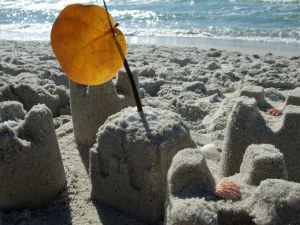
– sand castles and leaf flags; my brother Mr. Gershwin, the Bird, and I had grand sand castle dreams and labored long to bring them into fruition.  The contrast between that golden leaf and that vibrant aqua sea kept calling me back again and again into wonder and praise.

I am neither a spider nor a bird

Another journal entry … a few weeks into my return. Even before I came back to the U.S., I had the irrational urge to skip the plane ride home and run as far away as I could.  This desire came in intensifying waves all summer, so I decided to go on a spiritual retreat to a place called the Farmhouse; my hope was to do the same kind of preparation for re-entry that I had done for my year abroad while at Taizé.  Of course,  this preparation came several weeks into the homecoming – and would last only 5 days rather than 5 weeks – but at that point I decided to take what I could get.

August 8, 2011

Last night/evening, I arrived at the Farmhouse.  Walking in was like coming home – to all the homes I knew and loved in Grand Rapids.  Dinner was delicious and the conversation stimulating, and the next-door house with my room, while not as home-like, was comfortable.  But then I took a walk in the woods, and that’s when I realized how wrong things were.  Not with the place, but with me.

I looked through the isles of corn to the small forest with great anticipation – the moon above the trees certainly helped to give it an adventurous quality – but my entrance was less than magical.

It’s funny – all last summer, I missed the cicadas and felt that the season had an empty space without their singing, but this summer, now that I am back in North America, I’ve found the cicadas’ sounds grating and distracting and even aurally claustrophobic.  I felt that way last night, too, and when I entered the woods, the twilight darkness intensified the claustrophobia.  I realized with dismay that my sandals, while sturdy and good for walking, exposed my feet to the poison ivy that I a) hadn’t had to deal with in Europe and b) had forgotten about as a problem to guard myself against.

So I picked my way carefully.  I was beset by persistent flies and mosquitoes.  The enormous dragonflies winding around me in the corn fields had felt like guardians, but these bugs buzzed in my ears with alarming regularity and yet managed to remain uncatchable.  I ran into spider webs, the oppressive heat pressed closer the deeper I got into the trees, and I hurried out on another path short of breath and flailing my arms to ward away everything I possibly could.  I’d never felt my self so fully reject the forest, and I knew I would have to return.

But not then.  I let myself be pushed away into the cornfield paths, rejoicing in the pastel moon and marveling at how my body was rejecting my homeland and seeking to flee.  The same way a body might reject its own organ.  I had hoped that leaving my parents house would calm my urge to run away as far as possible.  But the demons were not a symptom of my location.

I did have one positive experience with the woods, and it actually had to do with the spider webs I kept running into.  I thought about how often the spiders have to rebuild their homes, how it is a part of their rhythms and necessary for their sustenance.  There is such a beauty in their home-building work.  And I thought about how even the word “nesting,” a word used so often by my generation, comes from the lives of birds, and they rebuild their houses every year.

Of course, I am neither a spider nor a bird – I am a human woman – but certainly there is a good deal of beauty to find in this season of my life.  And plenty of nesting to do.

Be ever thankful (2)

This week I was thankful for:

– a long phone call to a faraway friend; sometimes it’s easy to pretend that we’re actually just sitting across the couch from each other

– a mother who lets me decorate for Christmas as part of my rent

– a workplace that lets me decorate for Christmas as part of my job

– clementines; it’s so easy for me to imagine how these little orange spheres of goodness featured so prominently in Christmas stockings of old

– the book The Vigil: Keeping Watch in the Season of Christ’s Coming by Wendy M. Wright; I’ve been wanting to read this book during Advent for probably about 10 years, and I finally pulled it off the shelf in time for the beginning of the season.    This slim but full volume has provided me ideas to rejoice over and chew on, and I probably don’t do it justice by reading it just before I fall asleep.

Advent, the season of waiting and preparation that comes before Christmas; as someone who often finds herself in in-between spaces, it is comforting to know that there is an entire liturgical season that the church has dedicated to in-between-ness.  More on that later.

Two days after a homecoming

It seems to me that there is a lot of information out there about culture shock and a traveller adjusting to foreign cultures, but I haven’t heard a lot of stories about people when they come home.  Perhaps that’s because all the stories are comparatively less exciting and, well, less foreign, but I think ending the sojourner’s story with the flight home is akin to ending a meal before all the silverware has been used: there’s something missing.  It’s not a truthful account of experience.  The return from the adventure is often seen as the last few moments before the credits roll, but of course real life doesn’t work like that.  You can’t edit the rest of a return out of your life.  And I think the confusing return to a homeland has a lot to say about who we are as Christians, as an in-between people.  I don’t pretend to offer any deep insight here; I will just recount experience.  I start off rather bleakly.  Bear with me.  From my journal, after my return to Grand Rapids, Michigan:

June 30, 2011

I’m not even sure where to begin. First of all, I am acutely aware of how anyone in Sparrows [coffee house] could read my writing.  Theoretically, at least.  We speak the same language, even if my handwriting is atrocious.  Not that I think anyone is going to be peering over my shoulder, but it makes me feel very exposed.

For some reason, I am terrible at writing when things are actually happening.  I also don’t know why I can’t shake my desire to catch up, which is never really possible anyway sine the feelings and reactions aren’t fresh.  And what do I hope to accomplish by writing everything down?  Who is my audience?  One thing I do know, however.  There have been entire episodes of my life that had slipped my mind before I read a journal entry about them.  But again, to what purpose am I remembering?

I think, to find a narrative.

This morning when I woke up, the insulation along the roof seemed oppressive, everything felt close and inescapable, and I wondered again why I hadn’t run away to Kazakhstan.

I decided to call my mom.  How glad I was to to be able to pick up a phone, whenever I took a fancy, and explain my thoughts to someone.

I saved up all my emotional disturbance for returning rather than leaving.  There’s no one great thing – other than finding myself in my homeland.  Which is, of course, not my home, just as I knew it wouldn’t be.  Prior to leaving, I wouldn’t let anything hit me because I knew I needed all my stewing energy for traveling.  Any time I did realize the import of every ticking second, I sprung for a book and drowned myself in other people’s strange lives.

Last night I finally felt the crushing weight of things moving faster than I know how to process them.  And even if everything did slow down, I still don’t think I’d know how to process them.  Every step out of Kathleen and Sarah’s house is overwhelming, sometimes to the point where I can’t catch my breath. (Though I’m not sure if that’s the result of overwhelming life or overwhelming comparative pollution.)  When the cashier at Sami’s Gyros complimented me on my bag, I hadn’t the faintest idea how to respond.  [People don’t do that in Eastern Europe.]  I’m afraid of people smiling at me because then I’ll have to expend the energy to smile back, so I put on my best disengaged European face and hope people don’t think I’m too rude.  The fact that I can understand every word people say is jarring and distracting; there’s still a catch in my chest at recognizing a fellow English speaker.  And I have the upmost difficulty not paying attention to what they are saying.