Praying the Hours

In her book The Artist’s Rule: Nurturing Your Creative Soul with Monastic Wisdom, author Christine Valters Painter invites her readers to the traditional monastic practice of praying the hours and offers the suggestion of writing personal liturgies for these prayer times in haiku form. I felt inspired by her prompt and created short pieces for each of the prayer times. Then I put the handwritten pages in a drawer and forgot about them for several years.

Last week, I was cleaning out some items and came across these prayers. I was unexpectedly moved. Obviously these poems meant something to me when I wrote them, but they have retained–and even strengthened–their significance. So I felt inspired to pull them out, edit them, share them, and find a way to incorporate them into my own daily liturgy. The last item on that list is still in progress, but I’m starting by sharing them now. Perhaps you, too, want to compose some haiku liturgies of the hours to accompany you into the new year.
Vigils
 (middle of the night)

Three a.m. again:
Night unfolded and soft,
Dream time, untethered.

All this open time,
Cradled in the Spirit’s hands,
Needs no other bounds.


Lauds (dawn)

Praise for the first sound
that tells me I’ve awakened.
Praise for the new breath.

Praise for the dawn light,
whatever its quality.
Praise the resting dark.


Terce (mid-morning)

Weary already
And dappled, too, with delight.
Joy comes with the morning

and must be received.
I place my hand on my heart.
Here I make a home.


Sext (noon)

Productivity
can never equal my worth.
Slow down and savor.

I move my body
to the dance of God’s great love
that draws me onward.


None (mid-afternoon)

Heavy the eyelids—
Grace doesn’t need my focus
to lighten my sight

No matter the length
of shadows or things undone,
Grace refills the cup


Vespers (dusk)

Everything can slow:
the heartbeat, the pace of talk
the ring of laughter.

Gather it all in
and let it settle in peace:
Like dew on dry ground.


Compline (bedtime)

Where was love present—
especially, tangibly—
in this time and place?

What do I long for—
especially, tangibly—
in this time and place?

The word of the Lord was rare in those days

I don’t remember why, but I was reading the story of Samuel and his mother Hannah in the book of 1st Samuel, and I was struck by a phrase that recurred several times: “the word of the Lord was rare in those days.” So I decided to write some song lyrics inspired by my meditation on the story.

1. 
The word of God was quiet then,
and visions weren’t so widely known.
Prayers were made by violent men,
who claimed the Holy as their own, 

When Hannah came to Shiloh’s heights
and fell upon its sacred ground. 
She poured her offering of tears,
mouthing words without a sound.

“Don’t forget me, Holy One,
don’t ignore my desperate cry. 
If we can’t hear you, are you listening? 
Do you hear each anguished ‘why’?”

2. 
The word of God was quiet then,
and visions weren’t so widely known, 
so Hannah left and looked for hope 
all along the journey home. 

An answer swelled within her womb, 
a promise grew into her son.
When he was weaned, she brought him back 
in thanks for all the Lord had done. 

“I remember, Holy One,
how you listened to my cry.” 
Hannah turned her prayer to song
and lifted praise to Adonai: 

3. 
(The word of God was quiet then, 
and visions weren’t so widely known.) 
“My heart rejoices in the Lord.” 
She sang, “My strength’s in God alone.” 

“The mighty warrior’s bow has snapped; 
the stumbling ones are clothed in pow’r.
The barren woman rocks her child; 
the hungry feast on manna shower. 
 
“You remember, Holy One,
and you listen to our cry. 
Before I questioned, you were listening,
Before I asked, you gave reply.” 

4. 
The word of God was quiet then, 
and visions weren’t so widely known,
but Hannah sang with joyful faith
and nurtured seeds of hope she’d sown. 

Did her son, the prophet Samuel,
learn from her what listening means? 
Were the words of God so silent?
Whose holy visions were unseen? 

We remember, Holy One:
We must learn to hear your cry,
not in those who grasp at power,
but in the outcast asking why. 

He was moving his hands too much

I originally wrote this after the death of Terence Crutcher in 2016. It remains unfortunately relevant.

When they gunned God down on the side of the road,
they said God shouldn’t have moved his hands so much.

When they threw God in a prison cell for failing to signal at a turn,
they said she should have showed a little more respect.

When they shot God playing in a city park,
they said he looked so old, so threatening.

When they heard God lift up her voice to demand justice for her children,
they said she was too loud and shrill.

When they executed God in his own neighborhood,
they said he looked suspicious.

When they asked God who could throw the first stone,
he bent down in the sand to write us something.
We might know what it was if we hadn’t stopped him.
He was moving his hands too much.

Instructions for Collecting Sea Glass along Lake Michigan

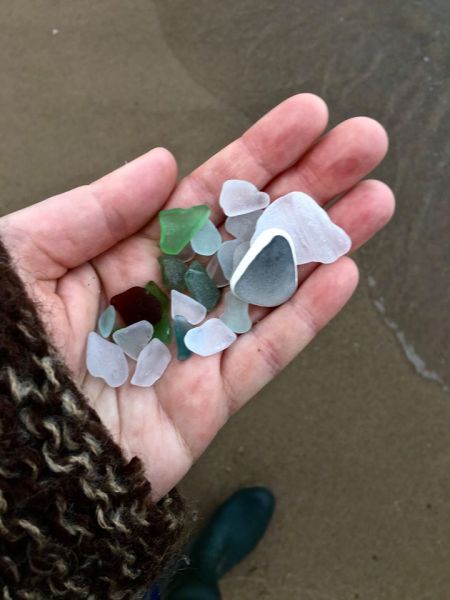
Yesterday I ventured to my favorite Evanston beach, longing for a sight of the wildflowers I knew would be there. I also walked along the shore and remembered a poem I had written last year about collecting sea glass in this season. Here it is. 

Springtime is sea glass season.
Early spring:
when the ice floes have dissolved again into churning lake,
but new leaves are only a thought curled in a budding branch.
The freshly-freed pebbles cast shadows on the wet and gleaming sand,
and lying between them
are rounded, sanded shards:
creamy white, jade green, coffee brown,
and oh-so-rarely
a weathered but brilliant blue.

The foraging is not hard:
wander along the waves
(it’s best in rubber boots)
until a shining flash or impossible color
catches your eye;
scoop up the object, with as little sand as possible;
rinse if necessary,
and if the surface isn’t still cloudy when wet,
the sea glass is not yep ripe;
the edges should be smoothed,
like the pebbles at your feet.
If the sea glass is ready,
slip it into your pocket
to clink with all the other treasures there.
You’ll know you have enough
when your pockets weigh heavier than your boots.

But if the sea glass is not ready,
if the patina washes off with the sand,
or a lingering sharpness remains,
there is still a job to be done.
Gently bury the shard in the crunchy sand
or toss it with vigor into the waves.
The earth and the water will continue their work,
slowly wearing down the sharp edges
and the shiny surfaces,
the brokenness softening into pieces rounded enough to hold,
until something miraculous remains,
something that another beach-goer,
with pockets weighed down
and boots squelching,
will gather in
and carry home,
or throw back to the water,
to begin again
and again
and again
the journey to ripening.

80973563_10100990074958794_7076796263336771584_o

We never left.

The robins never left this year.
I’ve heard them twice –
their light and lilting trilling
filling January air
damp with strange warmth.
Do they know something I don’t?
That the ground will never freeze,
and the maple sap will never run,
not this year,
not ever again,
maybe?
The robins always know.

On muggy summer evenings,
my windshield stays clear,
no arrhythmic tapping
of insects who meet their end –
splat –
on the glass.
There aren’t enough bugs left, you see,
to cover so much ground,
to fill the air with humming,
to remind me
as I drive
that I am only one
in a multitudinous world
beyond my comprehension.

The robins sing
and the insects are silent.

How will I know
when to look for trillium
or when to plant my salad greens?
If the robins never leave,
will the frost still creep up my windows
and seal me snugly
into winter’s dreaming time?
If the insects are so diminished
that their evening songs
grow dimmer and dimmer
each year
will I have to explain
to my friend’s little boy
why his napping white-noise track
is called
crickets?

I’m in a new world now,
but like the robins,
I never left the old one.

(image credit)

On Psalm 106

On Psalm 106


We move in circles,

spiraling around your presence

and our absence,

spinning from faith, to doubt,

to apathy,

and swinging around

to faith again

only through

centrifugal grace.

Fill our empty centers

with stories of your fullness,

until we stop seeking for signs and wonders

and rest in the miracle of movement.

Conversations I had with local flora and fauna on Monday, December 10th

4432DA55-CFD4-4BD2-8E09-B517B1786395

Walnut tree – are you a walnut? 

My forestry is less refined 

without leaves. 

Your ancient bark is so deeply ridged –

I want to fold myself inside

and learn from you

the slow pace of winter sap rising. 


Is there a minute network 

of chattering fungi beneath my feet?

My tree book suggests there is,

but you are a newly reborn forest, 

so recently returned to life from clear cut ground. 

Has your speech returned?

We silenced you because

we didn’t know what we were doing. 

But I am listening now. 


I was walking too loudly –

I’m sorry –

cracking ice and branches and frost. 

But now I’m stopped and waiting and still,

and you can come out again, 

chickadees and sparrows 

and whatever bird you are,

nearly infinitesimal,

almost hidden by the branch you land on. 

Hop, scuttle, peck. 

A bright yellow stripe

crowns your tiny head,

and I’m not sure that I have ever seen you before. 

Genus? Species?

For the first time ever,

it occurs to me 

to ask you what you call yourself. 


Equine companion,

who rode through here sometime last week,

might you have left your piled gift

somewhere easier to get around?

F0A6F816-B9FE-439A-8495-A3C51072FD47

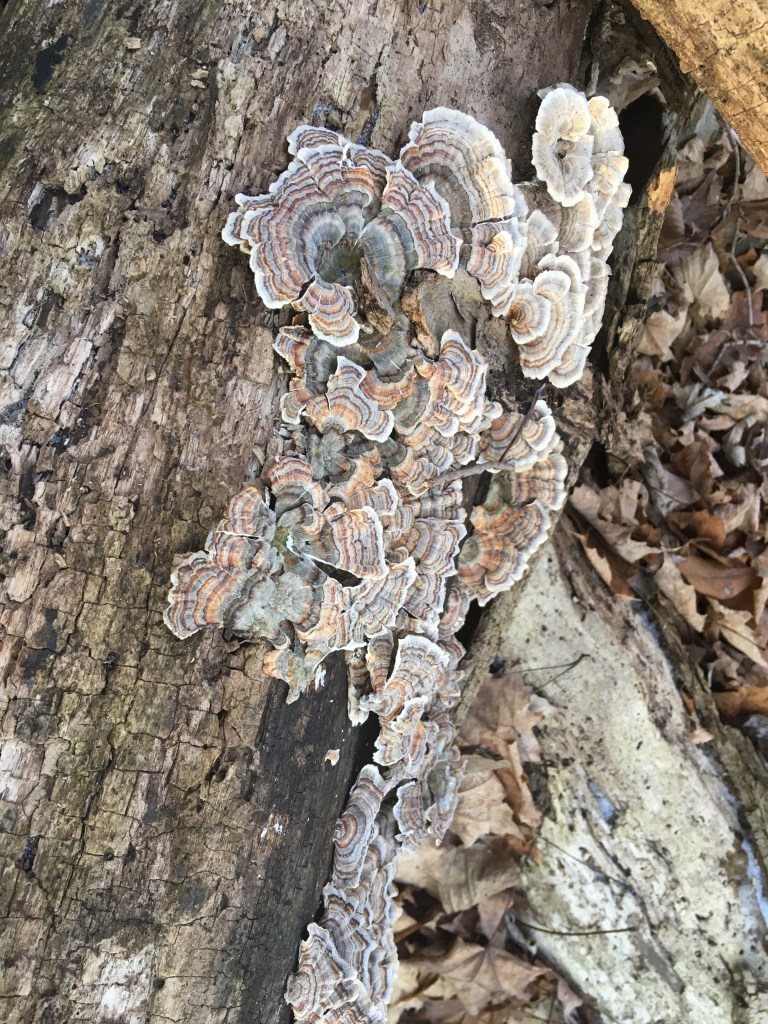
O, great mystery!

A canyon of color 

contained in a mushroom. 

You are a bearer of worlds. 


The river breathes. 

More slowly than humans,

and even than the green things,

but there is a rhythm,

in and out,

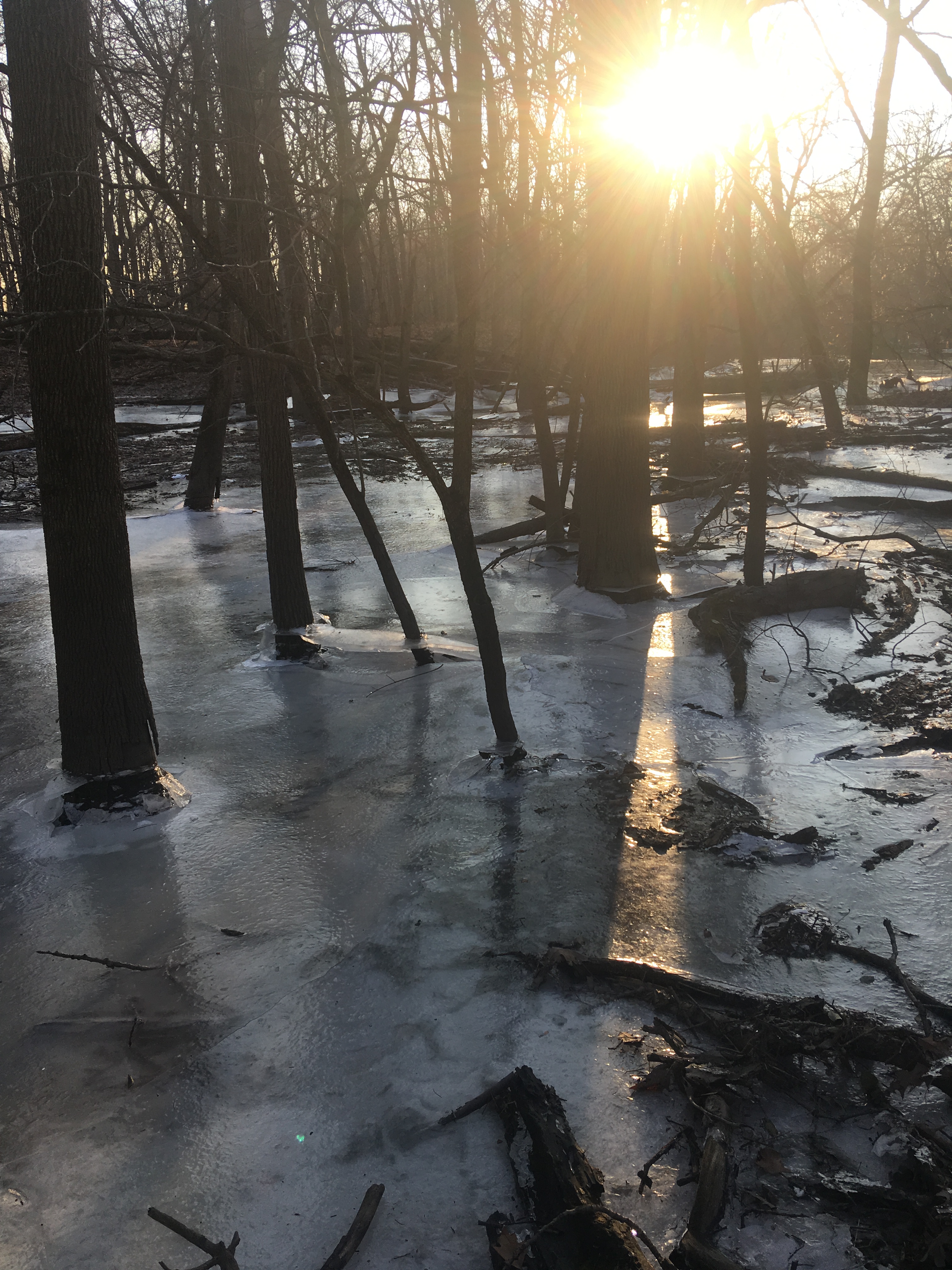
and I can see it in the ice on the flood plains –

in the layered ice rings around your trunks,

and the cracked lines dipping in the sheets of ice above your roots,

proof of water levels moving

up and down,

expanding high,

and compressing low,

like lungs,

water like air,

the earth a body,

where a flood is not a disaster,

but a deep breath in.


You really wanted to see that bridge,

my own dear self,

and when one way was blocked

by thunder-cracking ice

with slowly breathing water pulsing beneath it,

you came this way. 

Was it worth it?

On most paths,

the mud is frozen

in space and time

with prints preserved

of human, deer, horse, raccoon,

and maybe occasionally

a dog.

But this path,

this leaf-strewn,

mud-caked, 

water-widened way,

is quickened by the breathing river,

and your feet sink into the loam,

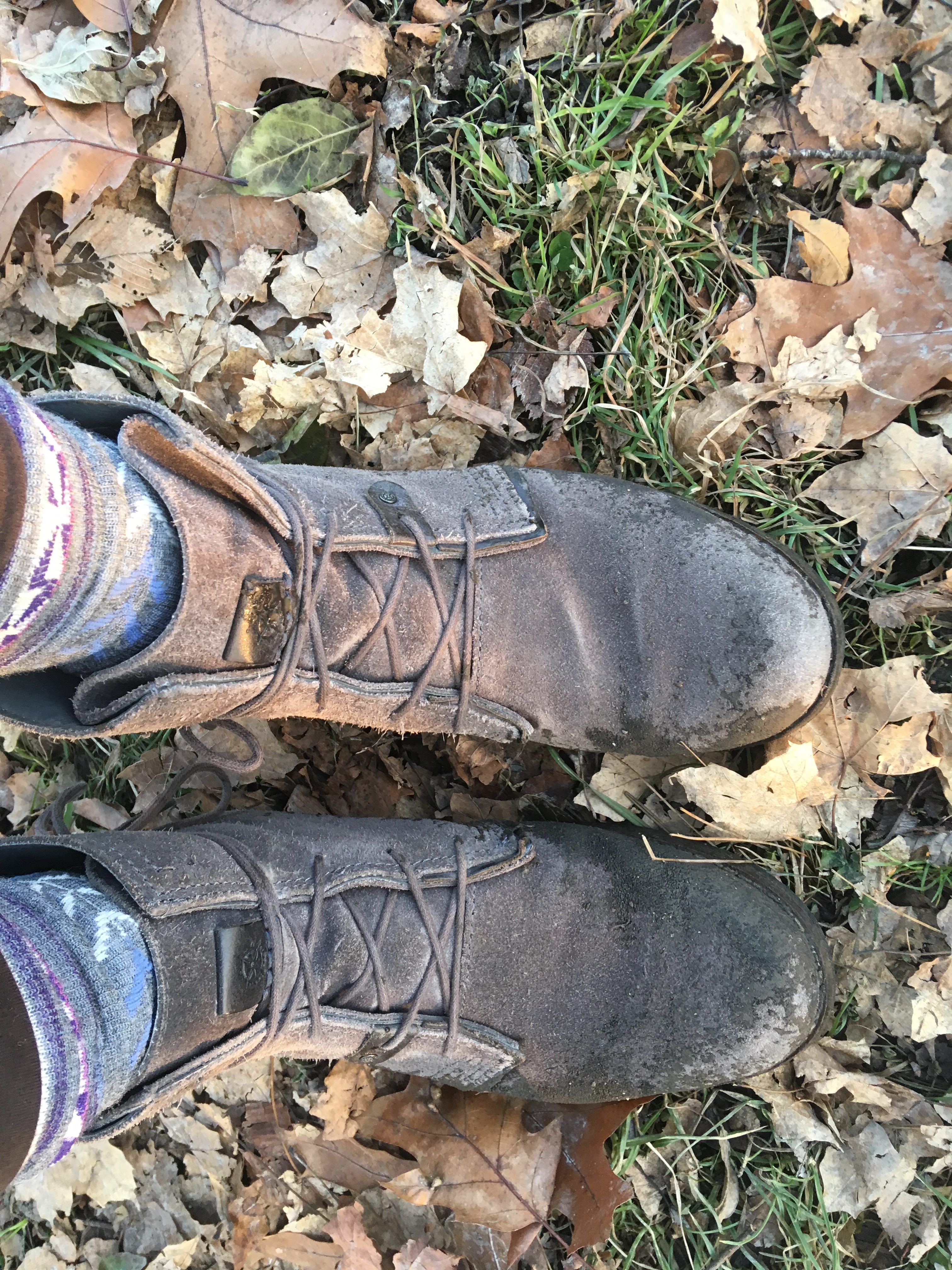
muddy water rising over your grey suede boots. 

Cold feet. Potentially ruined shoes. 

It wasn’t so much that the bridge was worth it,

was it, my own dear self,

but that the setting sunshine,

and the sliding black river,

and the maple leaves still hanging,

were calling for a witness. 

C5129B0D-63B1-4423-8379-9F825B18E6BB


Thursdays in the Lectionary – Stones

I do know it’s not Thursday … I’m a day late with this post because yesterday I was busy finishing up my FIRST YEAR OF SEMINARY!  It was a pretty grand day.  The world got so excited about it that it forgot what season it is and snowed today. 

Rachel Held Evans, a writer and thinker I have long admired, began a new series in which she will be dedicating her Thursday blog post to the coming Sunday’s lectionary texts.  She invited her readers and fellow-bloggers to join her in this task of delving into the Bible as a community – whether through a traditional sermon, a poem, a reflection, art – and I am taking up that invitation.

This week’s texts are: Acts 7:55-60, Psalm 31:1-5, 15-16, 1 Peter 2:2-10, John 14:1-14


One Stone

I jumped on the shovel

shlmph

It sliced into the hard-packed earth

Roots and sticks and last year’s leaves turned over and under

klink

I shove aside the dirt and look down to the heart of the world.

Will I hurry away

and sell everything

for the the Stone I see there,

One large enough to host the the longing of universe

and build it into reality?

It was so terrifying,

they buried it in the loam of the garden,

hoping it might grow there into something more

manageable.

Two stones

They fit like they had always been together

one stone next to the other

breathing with one sturdy lung

binding the whole wall together

into a sanctuary of holy possibility.

Three stones 

When I ran into town

and told them all about the wall I had built,

with the Heart-stone pulsing powerfully at the center,

I asked them to come and see

and imagine with me

just what kind of

roads and bridges and homes

such a living wall could offer.

Lord, do not hold this against them:

three stones hurled in fear.

We will pick them up together

and add them to the wall.

The cornerstone is large enough

to hold every stone they throw.