Feast of the Annunciation

I wrote this hymn during the season of Advent this past year because I longed for new lyrics to the familiar carol “God Rest Ye Merry, Gentlemen.” But this song also is appropriate for March 25, the Feast of the Annunciation, the day we celebrate the angel’s visit to Mary and Mary’s perplexed but wholehearted ‘yes.’ I was inspired both by Mary’s own song and by St. Basil’s ancient words: “Annunciations are frequent; incarnations are rare.” What seeks to be made alive in you today?

The angel came to Mary with the message, “Do not fear!

You are the highly favored one, and God is with you here,

For you will bear the Son of God and bring God’s kingdom near!”

O, tidings of comfort and joy, comfort and joy! O, tidings of comfort and joy!


When Mary heard the angel’s words, she asked, “How can this be?”

The angel opened up to her the sacred mystery,

And even then her longing grew for all to be set free.

O, tidings of wonder and joy, wonder and joy!  O, tidings of wonder and joy!

And Mary told the angel, “Here I am to serve the Lord.

I will receive God’s promises according to your word.”

And she prepared her heart to hold the Spirit then out-poured.

O, tidings of mercy and joy, mercy and joy! O, tidings of mercy and joy!

Then Mary raised her voice to God in hopeful, thankful song:

“God has begun the turning we have waited for so long:

Redemption comes to lift the weak and to reshape the strong!

O, tidings of justice and joy, justice and joy! O, tidings of justice and joy!”

The angel comes to each of us, invites us all to bear

God’s love made flesh within our lives. So let your hearts prepare!   

Will Mary’s yes take root in us and grow until we share

God’s tidings of comfort and joy, comfort and joy? God’s tidings of comfort and joy!

When we know where the fire burns

Due to the peculiar nature of layovers, my flight back to Chicago from Southern Oregon took me through Los Angeles. As we flew over the California coast, I saw billows of smoke rising into the air—evidence of the wildfires tearing their way across the dry ground. I was sad, even disturbed, by these fires; they poked at my desperate feelings about climate change and environmental preservation. But I was removed from them in every possible way, soaring miles above in a machine that only added fuel to the fire of the climate crisis.

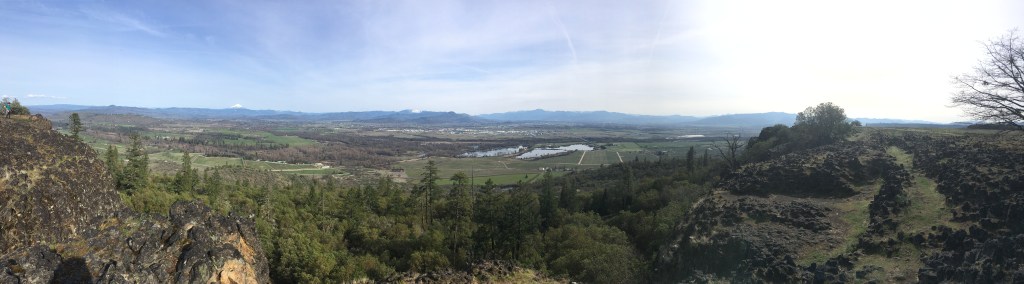
Instead, my mind was on Oregon and the beautiful Rogue River Valley I’d left behind. I had been there for a storytelling training, once in March to begin and once in October to close out. The place had captivated me—three mountain ranges joined and merged at this valley, filling the horizon with sharp blue shadows. The terrain—the climate, even—varied depending on what side of the mountain you stood on, or how far up you were. I explored mossy creek gullies and snow-capped peaks, drove down winding roads through oak savannas and sat in quiet pine forests. I hiked up volcanic landscapes and watched the valley spread out beneath me. I loved the way the topography was open enough to be a like a map—I could see each landmark no matter where I was, miles and miles away, and hold the shape of the valley in my mind.

At night, I watched the mountain shadows fall over the pastures and vineyards, and I breathed in the smell of wood smoke. In the morning, I cut up pears grown nearby and saw the sun move over the Cascades. This place brought me such deep peace and gratitude.

Almost a year has passed since that trip, and we’ve circled back around to wildfire season again. I’ve watched with pity as the skies across Washington and California fill with smoke. I’ve wondered how long it will be before we finally take climate change and it’s exacerbating effects seriously. And then, this week, I saw the news on my facebook feed, echoed by the many friends I’d made in Oregon: the Rogue River Valley was burning. The fire was un-contained. The wind was whipping the flames past the farm I’d stayed at during both visits. A colleague’s house was burning down.

Pain filled my stomach. The images of towering flames caught my breath. I felt like I wanted to throw up. Helplessly, I listened to a live video as the firefighters named roads I knew and prepared to evacuate whole communities. In my mind’s eye, I could trace the path of the fire as it devoured that beautiful place. I cried. I railed. I was no longer in an airplane looking down at a distressed but unfamiliar landscape. I was all but choking on the ash made up from a place I loved.

We cannot save the world in the abstract. That’s not how we humans work. The word “courage” comes from the word “heart,” and we fight most fiercely for what we love. The magnitude of the ecological crisis we face—climate change, species loss, ocean acidification, melting glaciers, fiercer storms, degraded soil—it’s all too much. One brain cannot face the enormity of it all and still have the power to act.

So, instead, we must let little pieces of the miraculous world God so loves into our own unfathomable hearts. And it is then we witness how God’s own passion blazes within us, ready to travel through overwhelming grief and impossible odds to show us just how much we love the world, too. We feel our kinship with some small space on the planet, and we grow a determination to help that place flourish.

I can’t stop the fires scorching the beautiful Oregon valley that has captured my heart. Not a single one of us can clean up the whole ocean or reduce carbon emissions enough to make a difference. But because I have opened wide my heart to the love of God present in some small patch of God’s good creation, I will find the courage to love the earth well. To protect the places that bring me delight. To cultivate the imagination needed to envision new systems of energy and commerce. To re-align my rhythms with that of the place I call home. Even to let go of the possibility of ever visiting Oregon again, if that’s what it takes to protect what I love. If we are driven by fear, we will fail. When we are driven by love, that’s when miracles happen.

The change we seek won’t happen overnight, but, spurred by love and sought together, it will grow like fresh new plants after a forest fire—resilient and ready and bursting with hope.

Water is Life

I got this swooping, sinking, rushing feeling when I saw my professor’s facebook post.  He was planning to answer the call for clergy to come to Standing Rock next week, he said.  And would any students like to join him.

I didn’t really want to go.  I knew what camping in the freezing cold was like.  I’d seen the videos of violence against protesters.  I had a full schedule in the week ahead.  And I felt woefully unprepared.  But something deeper than desire and stronger than fear rose up within me and whispered, “Go!”

So I emailed my various supervisors and professors and asked if arrangements could be made for me to miss 4 days of work and classes, a not-insignificant part of me hoping they would say “no.”  But they didn’t.  They told me that this was an important opportunity and that they would make things work.  And the whisper inside me grew bolder and said, “Go.”

I decided to sleep on it and pray for guidance and had a very distressing but unhelpful dream about biking across Europe in the autumn and falling over on 3 person a bicycle into a mud pit.  The morning found me both weary and wired.  And the voice raised itself up inside me and shouted, “Go!” I knew that if I silenced that voice, I would silence something essential in me.  Call it my conscience, my vocation, a sense of justice, the Holy Spirit living in me – more than I wanted to stay home, I wanted to listen to that call and stand with those who needed allies.

There are several camps now at Standing Rock, all working toward the same purpose: halt the death-dealing black snake of the Dakota Access Pipeline.  This pipeline and the oil it carries represents disregard for native lives and well-being, a threat to water sources, and a victory for big oil companies rather than a move toward sustainable energy solutions.  The Water Protectors (the preferred term, rather than protesters) have been using non-violent forms of resistance to call attention to the unjust and unethical practices of the pipeline construction.

This past week, a call was made to clergy all over the nation to join the Water Protectors at Standing Rock and stand in solidarity.  This is a crucial time for the work against the pipeline.  Violence and force from law enforcement is increasing, winter weather is beginning to set in, and the tribes gathered at Standing Rock need our support.

I am going with 11 other Garrett-Evangelical students, professors, and alums, as well as 2 non-seminary-affiliated folks.  We’re joining clergy and people of faith and people of no faith from all over the country to stand with those at Standing Rock.  We’ll be leaving Tuesday, arriving in Cannonball, North Dakota, on Wednesday, and participating in the clergy solidarity action on Thursday.  We’ll make the long trek back on Friday.  We ask for your prayers for strength, wisdom, peace, and justice.

ict_editoon_090416

Behind that tiny word “Go!” are so many convictions that God has grown in me over the years:

  • God made the world and made it good (Gen. 1)
  • God includes the whole earth in God’s vision for community and justice (Lev. 25, Isaiah 11)
  • In the incarnation, Jesus was born, lived, died, and resurrected as a human, fleshy body who walked on this physical earth – in the incarnation, God affirms the goodness of Creation and brings the whole world into the redemption story (John 1, Romans 8).
  • All of Creation will be made whole (Romans 8, Isaiah 65).
  • Our God is One of justice and mercy, and God stands with the oppressed and the marginalized (Matthew 25, Luke 18, Isaiah 1 and 58).

I go to Standing Rock because of the God I serve and the kingdom of God that I am called to join.  I ask you to join your hearts and prayers to mine, and together we will work for the good of all God’s people and land.

More information from those on the ground about the history and situation:

http://standwithstandingrock.net/history/

This article is a couple months old, but it gives good background information:

http://indiancountrytodaymedianetwork.com/2016/09/26/sierra-club-no-dapl

If you have very warm winter gear – coats, boots, tents, sleeping bags, etc. – or hygiene items that you want to send with me, let me know.  Here are other ways to help:

http://act.350.org/sign/stop-dakota-access-pipeline?akid=s197373..Z7kCFf

Finally, you may be thinking, “This sounds like a good cause and all, but doesn’t it defeat the purpose to use a lot of oil/gas and drive out there?”  Good question!  We still live in an oil-based economy, and there just aren’t a lot of good options for traveling without using petroleum.  This is in large part due to the subsidies oil companies receive and the huge amounts of money and political power our nation grants them.  If enough of us can stand up and say NO to the Dakota Access Pipeline, then we may be able to have enough people power to imagine and enact new, healthy, sustainable and just ways of being a society.