Instructions for Collecting Sea Glass along Lake Michigan

Yesterday I ventured to my favorite Evanston beach, longing for a sight of the wildflowers I knew would be there. I also walked along the shore and remembered a poem I had written last year about collecting sea glass in this season. Here it is. 

Springtime is sea glass season.
Early spring:
when the ice floes have dissolved again into churning lake,
but new leaves are only a thought curled in a budding branch.
The freshly-freed pebbles cast shadows on the wet and gleaming sand,
and lying between them
are rounded, sanded shards:
creamy white, jade green, coffee brown,
and oh-so-rarely
a weathered but brilliant blue.

The foraging is not hard:
wander along the waves
(it’s best in rubber boots)
until a shining flash or impossible color
catches your eye;
scoop up the object, with as little sand as possible;
rinse if necessary,
and if the surface isn’t still cloudy when wet,
the sea glass is not yep ripe;
the edges should be smoothed,
like the pebbles at your feet.
If the sea glass is ready,
slip it into your pocket
to clink with all the other treasures there.
You’ll know you have enough
when your pockets weigh heavier than your boots.

But if the sea glass is not ready,
if the patina washes off with the sand,
or a lingering sharpness remains,
there is still a job to be done.
Gently bury the shard in the crunchy sand
or toss it with vigor into the waves.
The earth and the water will continue their work,
slowly wearing down the sharp edges
and the shiny surfaces,
the brokenness softening into pieces rounded enough to hold,
until something miraculous remains,
something that another beach-goer,
with pockets weighed down
and boots squelching,
will gather in
and carry home,
or throw back to the water,
to begin again
and again
and again
the journey to ripening.
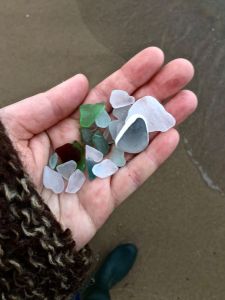
80973563_10100990074958794_7076796263336771584_o

Living Holy Saturday

When I was in college – when Facebook profiles still fit on one page and I tended toward a bleaker spirituality – my religious views on Facebook read: “We live in a Holy Saturday.” My point, I think, was to highlight the “already-not-yet” nature of Jesus’ beloved community, the waiting and unsureness we all feel when we are seeking God in the world. Today, it would be more accurate to say I believe we migrate through Holy Saturday, again and again, as part of our wrestling with the Divine. And right now, I think, many of us are camped in Holy Saturday, waiting, alone, not sure how to be hopeful.


I’ve often imagined what it would have felt like to be one of the women who followed Jesus, waiting for a whole sabbath day to anoint his body, sitting observantly still on the outside but tangled with fear and confusion and shock within. I’ve imagined a sort of heavy grayness, even on Holy Saturdays when the sun shines brightly. What would it feel like to believe that God had be executed, tortured, killed? To live without even an echo of resurrection?


When I walked to my congregation’s meeting house yesterday, preparing to set up the Zoom broadcast for our Good Friday service, I felt a profound sense of unreality. I couldn’t make my mind remember that I would be in the sanctuary alone, that my worship collaborators would be visible only through a screen, that every house I passed was filled with people sheltering in place, that New York had started digging mass graves for virus victims. I still felt numb when the service ended. I put away the worship elements in an empty building, and when I got home and climbed into bed, I tried to imagine what Easter could be. I cried. And I waited.


I was hoping, by the time I got to this point in writing this post, that I would have something profound to say. But I don’t. I just have emotions calling out past the numbness for expression. Anger at systems that have not prioritized the vulnerable. Grief for the many little normalcies my life has lost. Sadness for the people dying and mourning alone.  Fear as I wonder what parts of our world will be resilient. There is no other call in this moment but the call to stillness, to sit with the reality of the world as fully as I can. The women who followed Jesus knew that their task with the jars of spices would wait. They all could wait.


Most of the theological explanations for what Jesus did on Saturday have focused on the “harrowing of hell,” a sort of final victory for Christ over the death-dealing powers of Satan. The Apostles’ Creed states that Jesus “descended into hell” as its only description of what happens on this strange Saturday. No one actually knows what happened. And knowing what happened, I think, is not the point. All we can know – what can give us consolation – is that whatever happened, Jesus was present in this day, in this unreal, isolated, waiting day. And Jesus is here with us still.